



A Glimmer in the Dark
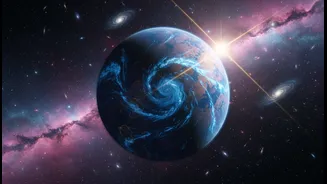
Imagine a moth flying in front of a distant streetlight. From far away, you can't see the moth itself, but you might notice the light dim ever so slightly as it passes. Astronomers use this same principle to study exoplanets—planets outside our solar
system. When an exoplanet passes in front of its host star from our point of view, it’s called a 'transit'. During a transit, the planet blocks a tiny fraction of the starlight, causing a minuscule dip in the star's brightness. Powerful telescopes can detect this dimming, which not only tells us a planet is there but also gives us clues about its size. But the real magic happens when scientists look closer at the light that skims through the planet's atmosphere on its way to us.
The Starlight Barcode
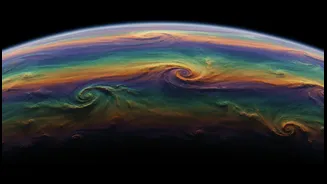
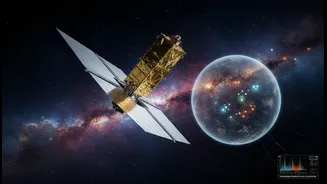
The technique scientists use is called transit spectroscopy. Think of starlight as pure, white light, containing a full rainbow of colours or wavelengths. When this light passes through a planet's atmosphere, gases in that atmosphere absorb very specific colours of light. Each gas—like water vapour, methane, or oxygen—has a unique 'fingerprint' or 'barcode' of light it absorbs. By capturing the starlight that has filtered through the atmosphere and seeing which colours are missing, astronomers can identify the gases present. This process turns starlight into a detailed chemical inventory of a distant world, revealing the composition of its sky from light-years away. Advanced observatories, most notably the James Webb Space Telescope (JWST), are designed to be incredibly sensitive to these subtle changes in infrared light, which is invisible to the human eye but rich with chemical information.
What We Look For
So, what are scientists hoping to find in these atmospheric barcodes? They're searching for key molecules that can tell a planet’s story. The presence of water vapour, for instance, is a crucial ingredient for life as we know it. Methane and carbon dioxide can offer clues about geological or even biological activity. Instruments on the JWST have already confirmed water vapour and even signs of active chemistry, like sulphur dioxide, in the atmospheres of hot, giant exoplanets. These findings help scientists understand how planets form and evolve, especially those that orbit extremely close to their stars. While a single gas isn't definitive proof of anything, the combination of certain gases can be very telling.
The Search for Another Earth
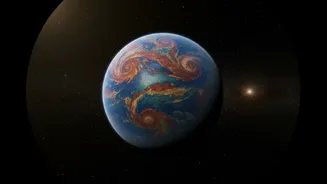
The ultimate goal for many astronomers is to find 'biosignatures'—gases that are unlikely to exist in large quantities without life producing them. On Earth, the most prominent biosignature is oxygen. Oxygen is highly reactive and would disappear from our atmosphere relatively quickly if it weren't constantly replenished by photosynthesis from plants and other organisms. Finding a similar abundance of oxygen in the atmosphere of a rocky, Earth-sized planet within its star's 'habitable zone'—the region where liquid water could exist—would be a monumental discovery. However, scientists are cautious, as non-biological processes can sometimes mimic biosignatures, so confirming the presence of life requires careful consideration of the planet's full context. The combination of gases like oxygen and methane, which naturally destroy each other, would be a particularly strong sign of a living world actively replenishing its atmosphere.