




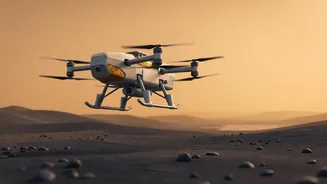

What is the Dragonfly Mission?
Dragonfly is a NASA mission set to launch a rotorcraft lander to Saturn's largest moon, Titan. Unlike the rovers that have explored Mars, Dragonfly is a dual-quadcopter—a drone with eight rotors—designed to fly from one location to another. Scheduled
to launch in July 2028, it will embark on a long journey, arriving at Titan in 2034. The mission's primary goal is to study prebiotic chemistry, evaluate the moon's habitability, and search for chemical signs of life. Developed by the Johns Hopkins Applied Physics Laboratory (APL), this revolutionary mission represents a new way to explore other worlds.
Why Explore Titan?
Titan is one of the most compelling destinations in our solar system for astrobiology. It's the only moon with a dense atmosphere, which is mostly nitrogen, similar to Earth's. More importantly, Titan is rich in complex organic molecules, the carbon-based compounds that are the building blocks of life. The moon has an Earth-like cycle of methane clouds, rain, and rivers of liquid methane and ethane that flow into vast seas. Scientists believe Titan's environment may resemble what early Earth was like before life emerged, offering a unique natural laboratory to study the chemical steps that could lead to biology. Evidence also points to a liquid water ocean beneath its icy crust, making it a prime target in the search for habitable environments.
An Explorer Built for Flight
Flying on Titan is surprisingly easier than on Earth. Its atmosphere is about four times denser than our own, while its gravity is only one-seventh as strong. These conditions mean a heavy craft like Dragonfly can achieve flight with relative ease. The car-sized rotorcraft will be powered by a Multi-Mission Radioisotope Thermoelectric Generator (MMRTG), which converts heat from decaying plutonium into electricity. This allows it to operate and recharge during both the long Titan day and night (one Titan day is 16 Earth days). During its mission, Dragonfly will perform a series of 'hops,' flying for several kilometres at a time to explore dozens of different sites, from sand dunes to the floor of an impact crater where liquid water may have once mixed with organic materials.
The Science Onboard
Dragonfly will carry a sophisticated suite of instruments to analyze Titan's surface and atmosphere. Its Dragonfly Mass Spectrometer (DraMS) will study the chemical composition of surface materials to look for biologically relevant compounds. To collect samples, it will use a drill system called DrACO (Drill for Acquisition of Complex Organics). The Dragonfly Gamma-Ray and Neutron Spectrometer (DraGNS) will measure the composition of the ground beneath the lander, while a geophysics and meteorology package (DraGMet) will monitor weather and look for seismic activity, or 'Titanquakes'. A suite of cameras, DragonCam, will provide detailed images from the surface and during flight, helping scientists scout new locations and giving us breathtaking panoramic views of this alien world.
A Mission of Great Challenges
Exploring Titan is not without significant hurdles. The extreme cold, with surface temperatures around -179 degrees Celsius, poses a major challenge for the spacecraft's electronics and mechanical parts. While the thick atmosphere helps with flight, it also creates more drag that the rotorcraft must overcome. Furthermore, the vast distance from Earth means there is a long communication delay, requiring Dragonfly to operate with a high degree of autonomy. It will have to navigate its own flights and conduct its scientific operations largely on its own. The mission recently took a major step forward, as engineers installed the complex electrical harness—the spacecraft's 'nervous system'—and the landing site was officially named Ahmakiq Undae, after a Mayan spirit who controls the wind.