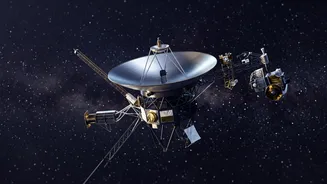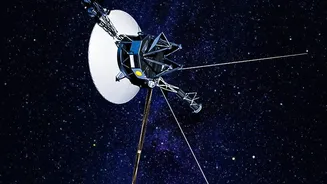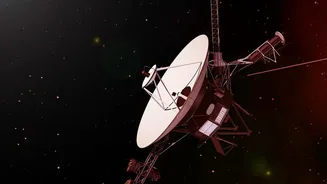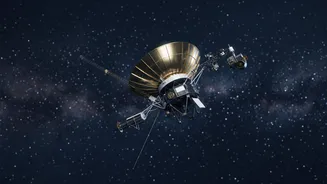



Sometime around November 18, humanity's farthest messenger, the Voyager 1 spacecraft, will achieve a staggering milestone. It will be one light-day from Earth. But what does that truly mean? The answer reveals the true scale of our cosmic backyard.
A 'Day' of Cosmic Proportions
First,
let's unpack the term 'light-day'. It isn't a measure of time, but of distance. It's how far a beam of light, the fastest thing in the universe, travels in 24 hours. That distance is an almost incomprehensible 25.9 billion kilometres. To put that into perspective, light from our Sun takes just over eight minutes to reach Earth. Voyager 1's new distance means it is about 173 times farther from us than we are from the Sun. It has taken the spacecraft, launched in 1977, nearly 50 years to travel a distance that light crosses in a single day. This milestone is a profound statement on the immense scale of space and the persistence of human engineering.
The Long Road to Interstellar Space
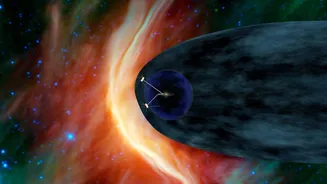
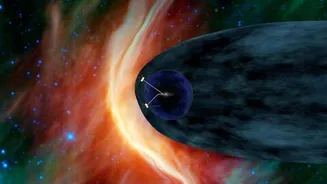
Voyager 1 wasn't initially designed for such a long journey. Its original five-year mission was a 'Grand Tour' of the outer planets. After launching in September 1977, it flew past Jupiter in 1979 and Saturn in 1980, revolutionising our understanding of these gas giants and their moons, discovering things like volcanic activity on Io and the complexities of Saturn's rings. After its planetary encounters, its trajectory flung it upwards out of the plane of the solar system and towards the stars. In August 2012, it made history by crossing the heliopause, the boundary where the Sun's stream of charged particles gives way to the interstellar medium — the space between the stars. It became the first human-made object to enter this new, uncharted territory.
A Conversation That Takes Two Days
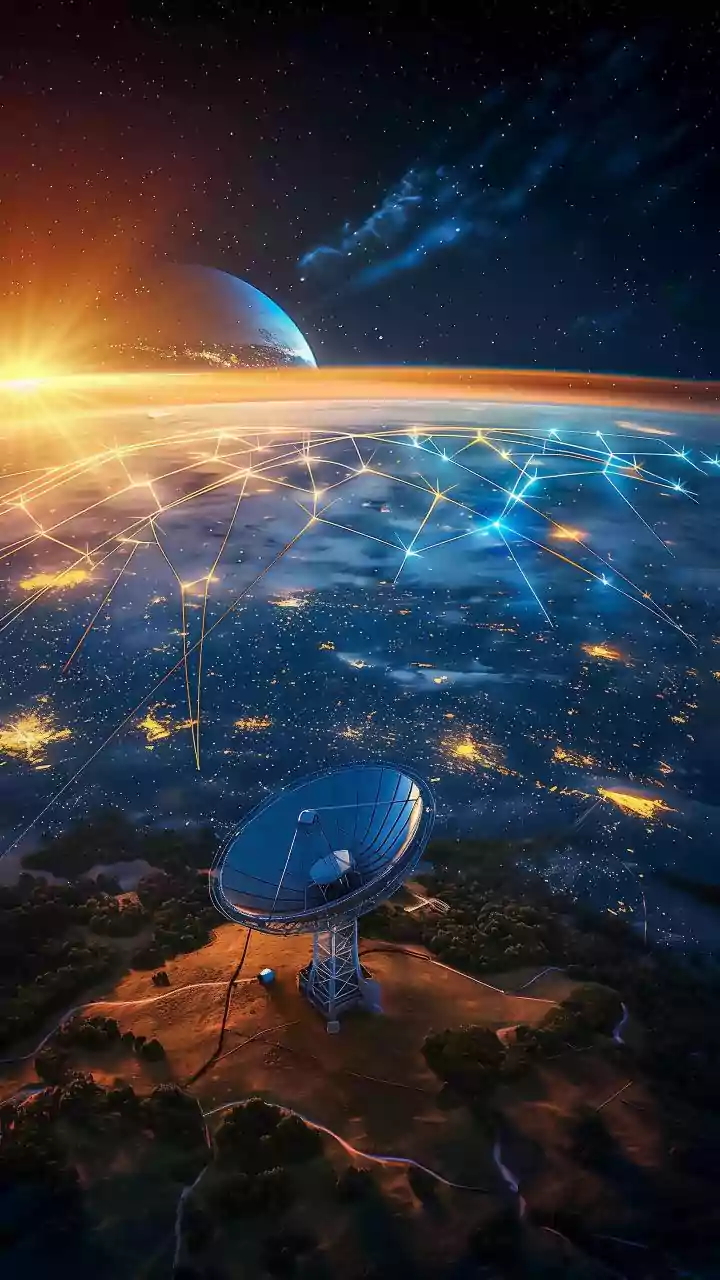
The one light-day distance has a very practical, and mind-boggling, consequence for communication. Since radio waves travel at the speed of light, on November 18, it will take a full 24 hours for a command sent from NASA's Deep Space Network to reach Voyager 1. Then, it will take another 24 hours for the spacecraft’s reply to travel back to Earth. This means a simple question-and-answer exchange will take at least 48 hours. This communication lag highlights the incredible challenges of operating a nearly 50-year-old probe in deep space. Engineers have had to overcome recent technical glitches, including a faulty memory chip in 2024 and a brief communications blackout in October 2026, all while accounting for this growing delay.
A Message in a Cosmic Bottle
Attached to the side of Voyager $1$ is a message in a bottle on a cosmic scale: the Golden Record. This gold $plated$ copper phonograph record contains sounds and images selected to portray the diversity of life and culture on Earth. It includes greetings in $55$ languages, music from different eras and cultures, and natural sounds like wind, rain, and animal calls. The idea, championed by astronomer Carl Sagan, was to provide a snapshot of humanity to any intelligent extraterrestrial life that might one day encounter the silent probe. As Voyager $1$ sails through the void, now a full light $day$ from home, the Golden Record travels with it—a testament to the hope and curiosity that propelled it on its journey into the vast, silent ocean of space.