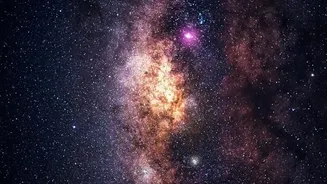



The heart of our Milky Way galaxy, a place of incredible density and energy, remains a profound mystery. It's a region packed with millions of stars and a supermassive black hole, yet it’s completely invisible to the naked eye. Why is it so hidden?
An Interstellar Curtain of Dust
The
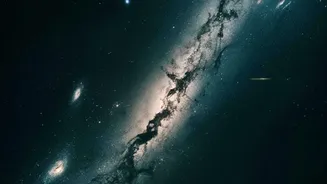
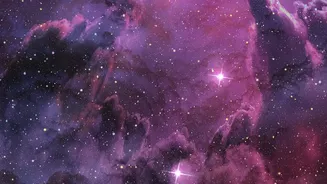
primary reason we cannot see the galactic centre is surprisingly simple: there’s too much stuff in the way. Between Earth and the core, which is about 27,000 light-years away, lie vast, thick clouds of interstellar dust and gas. Our solar system is located within one of the Milky Way’s spiral arms, and to look toward the centre, our line of sight must pass through the densest part of the galactic disk. This cosmic dust, composed of tiny particles of silicates, carbon, and other elements, acts like a thick interstellar smog, scattering and absorbing visible light. The effect is so profound that the light from the galactic core is dimmed by a factor of a trillion by the time it reaches us, rendering it completely invisible to our eyes and optical telescopes.
The Blazing Heart We Can't See
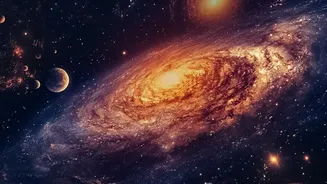
If we could somehow sweep away this dust, the view would be spectacular. The galactic centre is an extremely crowded and active neighbourhood. It hosts a nuclear star cluster, the densest and most massive star cluster in the entire galaxy, with a population of millions of stars crammed into a relatively tiny space. At its very heart lies Sagittarius A* (pronounced 'Sadge-A-star'), a supermassive black hole with a mass four million times that of our Sun. The stars here are so packed that if we lived on a planet near the core, the night sky would be perpetually ablaze with stars as bright as Venus. This concentration of light and energy is what should make the galactic centre the brightest part of our galaxy, much like we see in images of other spiral galaxies like Andromeda.
Peering Through the Veil with Technology
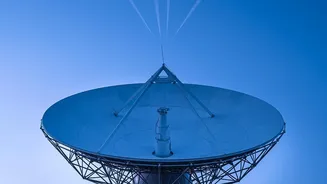
While visible light is blocked, astronomers are not completely blind. They have developed ingenious ways to bypass the cosmic dust curtain by using other forms of light that our eyes cannot see. Longer wavelengths, such as infrared and radio waves, are not as easily absorbed or scattered by interstellar dust particles. They can penetrate the obscuring clouds, allowing telescopes designed to detect this type of radiation to see what lies behind. This is why telescopes like the Hubble Space Telescope (in its infrared mode) and dedicated radio telescope arrays are crucial for studying the galactic centre. By observing in these wavelengths, astronomers can map the structures, trace the orbits of stars, and study the behaviour of gas clouds near the core.
What We've Learned from Indirect Views
Thanks to this multi-wavelength approach, our understanding of the galactic centre has grown immensely. Infrared observations have allowed astronomers to track the frantic orbits of individual stars, like one called S2, as they whip around Sagittarius A. By monitoring these orbits, scientists were able to calculate the mass of the black hole and confirm its existence long before it was ever 'photographed'. More recently, the Event Horizon Telescope, a global network of radio observatories, managed to capture the first-ever image of Sagittarius A itself. This was not a picture of the black hole, which absorbs all light, but rather of its shadow cast against the glowing, superheated gas swirling around it. Furthermore, X-ray telescopes have revealed a chaotic environment of high-energy events and massive star clusters, painting a picture of a dynamic and violent region that continues to shape our galaxy's evolution.