




A Day Longer Than a Year?
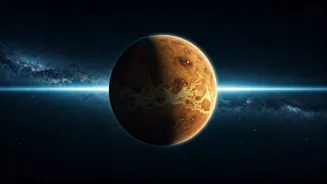
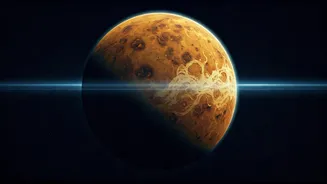
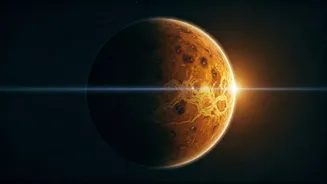
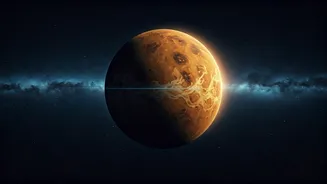
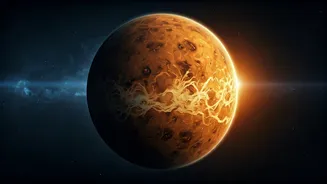
It sounds like a riddle, but it’s a simple, strange reality of orbital mechanics. A ‘year’ on any planet is the time it takes to complete one full orbit around the Sun. For Venus, this journey takes about 225 Earth days. A ‘day’ is the time it takes for
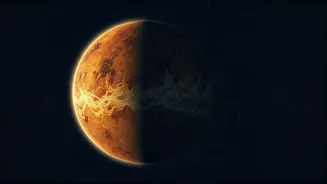
a planet to complete one full rotation on its axis. And here’s where Venus gets truly weird. It rotates incredibly slowly, taking a staggering 243 Earth days to spin just once. So, yes, a single Venusian day (243 Earth days) is longer than a Venusian year (225 Earth days). If you could stand on its surface, you would complete a full trip around the Sun before a single day-night cycle had passed. To make things even more confusing, the Sun doesn't rise and set once per 243-day rotation. Because the planet is also moving in its orbit, the time from one sunrise to the next (a solar day) is actually shorter, about 117 Earth days. It’s a mind-bending calendar unlike anything on Earth.
The Science Behind the Slow Spin
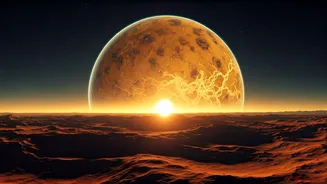
Why does Venus spin so slowly and, for that matter, backwards? Unlike most other planets in our solar system, including Earth, Venus has a retrograde rotation, meaning it spins in the opposite direction to its orbit around the Sun. If you were on Venus, the Sun would appear to rise in the west and set in the east. Scientists have several theories to explain this bizarre behaviour. One leading hypothesis suggests that Venus was struck by a massive asteroid or planetary body early in its history. Such a cataclysmic impact could have been powerful enough to not only slow its rotation to a near-standstill but also reverse its direction entirely. Another theory points to Venus’s incredibly thick and heavy atmosphere. Over billions of years, powerful atmospheric tides, created by the Sun’s gravitational pull on the dense blanket of gas, could have acted as a brake, gradually slowing the planet’s spin and eventually flipping it over.
A Planet of Extremes
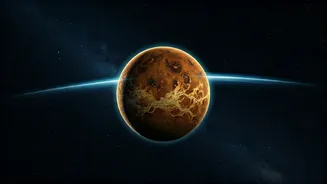
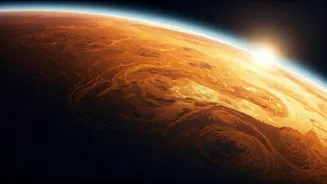
The long day is just one item on a long list of extreme features that define Venus. The planet is a true vision of hell, shrouded in thick, toxic clouds of sulfuric acid. Its atmosphere is over 96% carbon dioxide, which has created a runaway greenhouse effect. This traps heat so effectively that the surface temperature is a uniform 465°C, hot enough to melt lead. Day or night, pole to pole, the temperature barely changes. The atmospheric pressure at the surface is another crushing reality—it’s about 92 times greater than Earth’s. Standing on Venus would feel like being nearly a kilometre deep in the ocean. Any spacecraft that has landed there has survived for only a couple of hours at most before being cooked and crushed by the hostile environment. There is no water on its surface, only a volcanic, rocky landscape baked under a permanent, oppressive yellow sky.
Earth's 'Evil Twin'
For all its hostility, Venus is often called Earth’s ‘twin’. This is because the two planets are remarkably similar in size, mass, and composition. They are neighbours in the solar system, and it’s believed they formed from similar materials around the same time. Yet, their evolutionary paths diverged dramatically. While Earth developed into a haven for life with oceans and a stable climate, Venus became a scorching, toxic wasteland. Understanding why our twin took such a different turn is one of the most important questions in planetary science. Scientists study Venus to model how planetary climates can evolve and to understand the delicate balance of factors that make a world habitable. Venus serves as a cautionary tale, a real-life laboratory showing what can happen when a greenhouse effect spirals out of control.