




What Exactly Is Agrivoltaics?
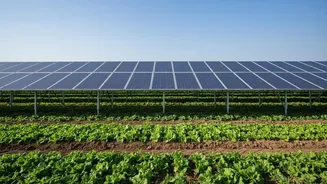
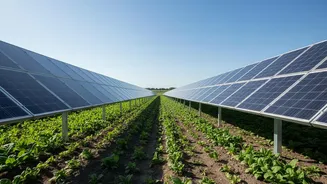
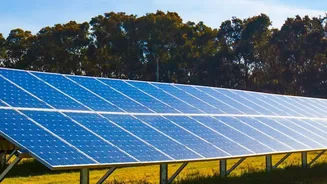
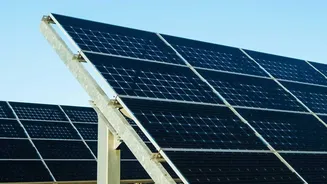
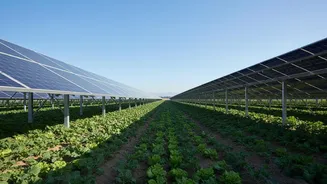
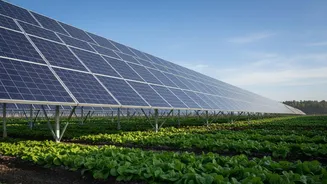
At its core, agrivoltaics—sometimes called agrisolar—is a simple but revolutionary concept: farming under solar panels. Instead of dedicating vast tracts of land exclusively to solar farms, this approach involves mounting solar panels on elevated structures,
several metres above the ground. This setup allows agricultural activities, from growing crops to grazing livestock, to continue on the land below. The goal is to create a symbiotic relationship where both energy and food can be harvested from the same plot of land, turning a potential land-use conflict into a productive partnership. This isn't just about saving space; it's about making both farming and energy generation more efficient and resilient.
India's Land-Use Dilemma
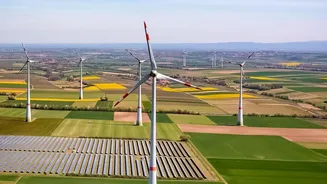
India faces a critical challenge. On one hand, the nation has ambitious renewable energy targets, including a goal to install 500 GW of non-fossil fuel capacity by 2030, a significant portion of which is solar. On the other hand, with agriculture employing nearly 43% of the workforce, arable land is a precious and often contested resource. Traditional, ground-mounted solar farms require large, open areas, often putting them in direct competition with agriculture for land. This has led to conflicts and slowed the pace of solar expansion in some regions. Agrivoltaics presents a compelling way to sidestep this dilemma, potentially unlocking thousands of gigawatts of energy capacity without displacing farmers or disrupting food production.
The New Policy Push
The "latest drive" isn't a single law but a series of coordinated policy signals, expert recommendations, and updates to existing schemes. The government's PM-KUSUM scheme, which promotes solarisation in agriculture, has already laid the groundwork by allowing solar plants on farmland. Recent discussions suggest that an upcoming version, PM-KUSUM 2.0, may include a dedicated component for agrivoltaics. Furthermore, a comprehensive study in late 2025 by the Climate Policy Initiative and the Power Foundation of India provided a detailed financial and policy assessment, showing that agrivoltaics projects are economically viable. These developments, along with recently published 'Best Practice Guidelines', are creating a clear roadmap for scaling up these projects nationwide.
Key Details Shaping the Future
The recent assessments add crucial detail to how agrivoltaics will be implemented. A key recommendation is to create a national mission for agrivoltaics to standardize definitions and streamline governance. Financially, studies have modelled feed-in tariffs, suggesting project viability and recommending that power ministries mandate the purchase of agrivoltaics power to guarantee revenue for farmer-producers. The guidelines also emphasize the need for site-specific planning, considering factors like crop type, panel height and spacing, and local climate. This ensures that the solar installation enhances, rather than hinders, agricultural productivity. For example, the shade from panels can reduce water evaporation and protect certain crops from extreme heat, potentially boosting yields.
What It Means for Farmers
For farmers, this initiative promises a significant boost in financial stability. Agrivoltaics offers two income streams from a single piece of land: one from selling crops and another from selling electricity generated by the solar panels (or leasing land for their installation). A pilot project in Rajasthan demonstrated that this dual-income model could increase a farmer's income by nearly tenfold. This provides a crucial buffer against unpredictable weather and crop price fluctuations, effectively creating a reliable "third crop" in the form of electricity sales. This transforms the farmer from just a food producer into an energy producer, or 'urjadata,' strengthening rural economies and energy security.
Challenges on the Horizon
Despite the immense potential, the path to widespread adoption has hurdles. The primary challenge is the high initial investment cost. The elevated structures required for agrivoltaics can make these systems more expensive than conventional solar farms. There is also a need for more research to determine which crops are best suited for cultivation under panels in India's diverse agro-climatic zones. Building farmer capacity and awareness is another crucial step, ensuring they have the technical knowledge to manage these integrated systems effectively. Clear and consistent policies regarding land use, grid connectivity, and financial incentives will be essential to de-risk investments and attract the necessary capital to scale the sector.