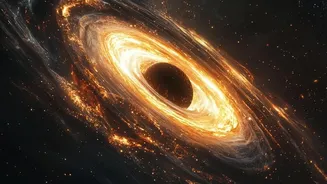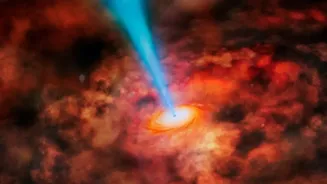


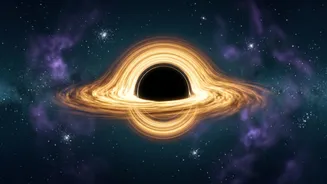
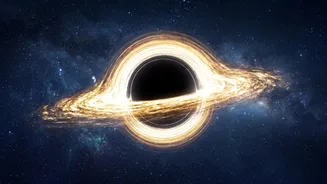
The universe is full of monsters, like the supermassive black holes sitting at the heart of most galaxies. But what if there’s something even bigger? Recent theoretical research proposes a new class of cosmic titan, and it could rewrite the story of the cosmos.
Beyond Supermassive: A New Class of Giant
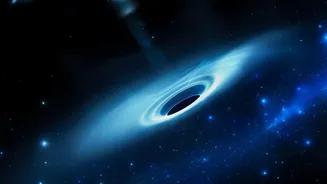
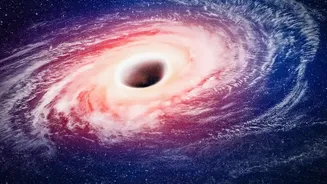
Astronomers are accustomed to dealing with mind-boggling scales. We have stellar-mass black holes, a few times the mass of our sun, born from the collapse of giant stars. Then there are the supermassive black holes (SMBHs), with masses equivalent to millions or even billions of suns, that act as the gravitational anchors for entire galaxies like our own Milky Way. The current heavyweight champion is TON 618, a colossal black hole with a mass of around 66 billion suns. But a new hypothetical category of object makes even TON 618 look modest: Stupendously Large Black Holes, or SLABs. This theoretical class describes black holes with masses starting at 100 billion times that of the sun and potentially reaching into the trillions. While none have ever been observed, physicists Bernard Carr and others have argued that their existence is theoretically plausible and could solve some of the universe's biggest puzzles.
Born in the Dawn of Time
So, how would you even build such a monster? The process that creates supermassive black holes — the gradual merger of smaller black holes and the steady consumption of gas and stars over billions of years — might not be enough. Scientists believe there's a limit to how big a black hole can get this way, likely topping out somewhere below the 100-billion-solar-mass mark. The theory behind SLABs proposes a different origin story, one that goes back to the very beginning of the universe. The idea is that they are a type of primordial black hole (PBH). Unlike their stellar cousins, primordial black holes wouldn't have formed from collapsing stars, as stars didn't exist yet. Instead, they would have formed directly from the collapse of extremely dense regions of energy and matter in the chaotic moments just after the Big Bang. This formation mechanism means they aren't bound by the same size constraints as black holes formed from stars.
Solving the Dark Matter Puzzle?
The existence of primordial black holes has long been debated, partly because they are a compelling candidate for dark matter. Dark matter is the mysterious, invisible substance that makes up about 85% of the matter in the universe, and we only know it's there because of its gravitational pull on galaxies. While SLABs themselves are too large and would be too sparsely distributed to account for all of the universe's dark matter, their confirmation would lend huge support to the theory of primordial black holes in general. If the conditions in the early universe were right to create stupendously large ones, it's highly likely they also created vast numbers of smaller, asteroid-mass or Earth-mass primordial black holes. These smaller PBHs could very well be the dark matter that astronomers have been hunting for decades. However, recent studies looking at the cosmic microwave background have put limits on this, suggesting SLABs cannot be a major component of dark matter.
How Do You Find a Hidden Giant?
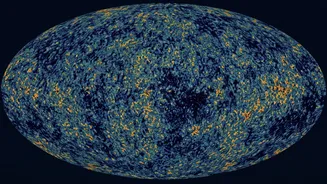
Detecting an object that, by definition, emits no light is an immense challenge. But a black hole’s immense gravity gives it away. One of the primary methods for finding a SLAB would be through gravitational lensing. An object this massive would warp spacetime so profoundly that it would bend and magnify the light from any galaxies or stars located behind it from our point of view. This could create distorted, repeated images of background objects, a cosmic funhouse-mirror effect that would signal the presence of an unseen giant. Another theoretical method involves looking for their shadows. A SLAB would be large enough to cast a detectable 'hole' or cold spot against the faint, uniform glow of the cosmic microwave background (CMB), the leftover radiation from the Big Bang. Researchers are actively exploring data from CMB surveys for these tell-tale negative sources.
A Challenge to Cosmology
The potential existence of SLABs forces scientists to rethink fundamental aspects of cosmology. For one, it challenges our models of galaxy formation. The current view is that supermassive black holes and their host galaxies grow together over cosmic time. But a primordial SLAB would predate the galaxy it sits in, flipping that relationship on its head. The galaxy would form around the already existing gravitational giant. The controversial 100 billion solar mass estimate for the black hole at the center of the Phoenix Cluster, known as Phoenix A, stems from this kind of modelling, where researchers explored what kind of object would be needed to explain the cluster's extreme properties. While that figure is a theoretical maximum and not a direct measurement, it highlights how these hypothetical objects could help explain some of most extreme environments we see in the universe. The search for SLABs is a search for any limits of what can create.