



In a landmark moment for space science, Indian and European researchers have joined forces. A new study, leveraging data from India's Aditya-L1 and Europe's Proba-3 missions, offers fresh clues to one of the greatest solar mysteries.
A Landmark Collaboration
Scientists at the
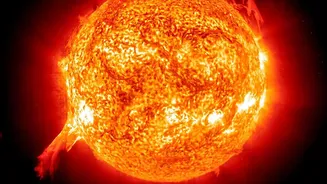
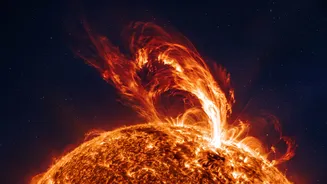
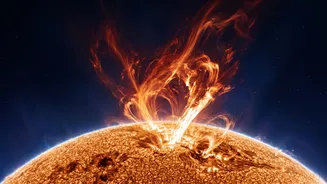
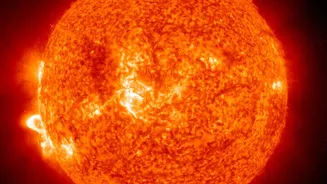
Bengaluru-based Indian Institute of Astrophysics (IIA), along with international collaborators, have published the first-ever joint analysis of solar eruptions observed by both India’s Aditya-L1 and the European Space Agency's (ESA) Proba-3 missions. The study, featured in the prestigious journal 'Astronomy & Astrophysics', focuses on Coronal Mass Ejections (CMEs), which are massive explosions of plasma and magnetic fields from the Sun's outer atmosphere, the corona. This collaboration marks a significant step forward in our quest to understand the Sun, combining the unique strengths of two of the world's most advanced solar observatories.
Two Missions, One Shared Goal
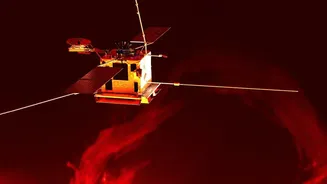
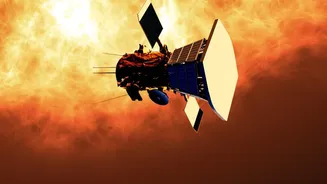
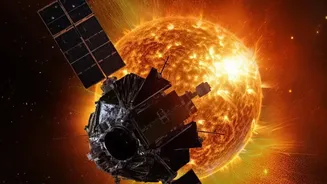
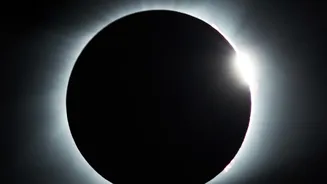
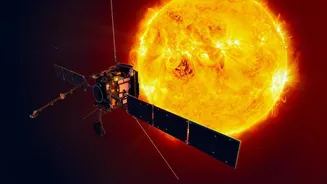
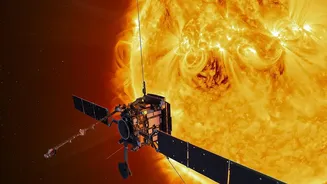
The success of this research lies in the complementary capabilities of the two missions. Aditya-L1, India's first dedicated solar observatory launched by ISRO in September 2023, is positioned at the strategic Lagrange point 1 (L1), giving it an uninterrupted view of the Sun. Its key instrument, the Visible Emission Line Coronagraph (VELC), performs spectroscopy, analysing the light from the corona to determine its temperature, density, and velocity. Meanwhile, ESA's Proba-3, launched in December 2024 by an Indian PSLV rocket, is a trailblazing mission in precision formation flying. It uses two satellites flying 150 metres apart to create a perfect artificial solar eclipse, allowing its ASPIICS coronagraph to capture incredibly detailed images of the faint corona very close to the Sun's surface. Together, one mission takes pictures (imaging) while the other analyses the properties of the gas (spectroscopy), providing a more complete picture than either could alone.
New Clues to Solar Eruptions
The joint study focused on two specific CMEs observed in September 2025. The data revealed two very different types of eruptions. One was incredibly fast, travelling at approximately 645 km per second, while the other was much slower, moving at around 145 km per second. By combining data from VELC and ASPIICS, scientists were able to measure the mass, density, and energy of these CMEs with unprecedented detail. For example, in the faster eruption, most of the energy was kinetic and magnetic, while in the slower one, thermal (heat) energy grew to become a significant component. These findings provide crucial new constraints on the physical processes that drive these powerful events, which has been difficult to study until now because observing the earliest stages of a CME is notoriously challenging.
Why This Matters for Us on Earth
While studying the Sun's atmosphere might seem like a distant academic exercise, it has profound practical implications. CMEs are a major component of 'space weather'. When these massive clouds of charged particles are aimed at Earth, they can trigger powerful geomagnetic storms. Such storms can disrupt our modern way of life by damaging critical infrastructure, including communication satellites, GPS navigation systems, and even terrestrial power grids. Understanding the origin and early evolution of CMEs is the first step toward accurately predicting their trajectory and potential impact. This joint research provides exactly that—a clearer, cross-checked view of how these events begin, helping to improve our space weather forecasting models and protect our technology-dependent society.