


Light’s Universal Speed Limit
Everything we see is thanks to light. But light, as fast as it is, isn't instantaneous. It travels at a staggering speed of nearly 3,00,000 kilometres per second. While that feels instant here on Earth—light from a lamp hits your eye with no perceptible
delay—the universe is unimaginably vast. When you look at the Moon, you're seeing it as it was 1.3 seconds ago. The light from our own Sun takes about eight minutes to reach us. If the Sun were to suddenly vanish, we wouldn't know about it for eight whole minutes. This simple principle is the key to understanding why the night sky is a time machine.
Introducing the Light-Year
Because cosmic distances are so enormous, kilometres become impractical. Instead, astronomers use the 'light-year'. It's not a measure of time, but of distance: it’s the distance light travels in one year. That’s roughly 9.5 trillion kilometres. So, when we say a star is 100 light-years away, it means the light we see from it tonight began its journey 100 years ago. You are seeing the star not as it is today, but as it was a century in the past. Every star you see in the night sky, apart from our Sun, is at least four light-years away. Most are much, much farther.
Greetings from Familiar Stars
Let’s put this into perspective with some stars you might spot from India. The brightest star in our night sky is Sirius, also known as Vyadha. It looks like a single brilliant point of light, but its glow has been travelling for 8.6 years to reach you. You're seeing Sirius as it was nearly a decade ago.
Look for the prominent constellation of Orion (Kalpurush), and you’ll find Rigel, the bright blue-white star that forms its left foot. The light from Rigel began its journey around the year 1200 AD, travelling for approximately 860 years. When that light left its star, the Delhi Sultanate was still in its early days.
Another famous star, Polaris or the North Star (Dhruva Tara), is about 433 light-years away. The light we see from it tonight started its journey in the late 16th century, around the time Akbar ruled the Mughal Empire.
Beyond Stars to Ancient Galaxies
The scale gets even more mind-bending when we look beyond individual stars in our own galaxy. On a very dark, clear night, far from city lights, you might be able to spot a faint, fuzzy patch in the sky. This is the Andromeda Galaxy, our closest major galactic neighbour. That faint smudge of light is 2.5 million light-years away. The light hitting your retina tonight left Andromeda long before modern humans even existed. You are looking at light that began its journey when our distant ancestors, of the genus Homo, were first walking the Earth. Every photon of light from Andromeda is a 2.5-million-year-old fossil.
A New Way to See the Sky
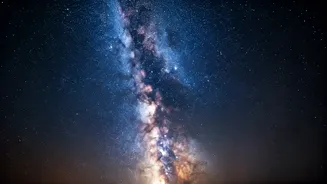
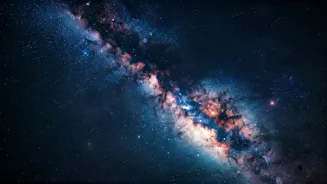
This cosmic time delay has profound implications. It means we can never see the universe as it is 'right now'. We only ever see its past. For all we know, a star that appears to shine brightly in our sky may have already exploded in a supernova a hundred years ago. We just haven't received the news yet. The night sky is not a static painting; it's a dynamic, layered collage of history. Each star is a different chapter, a different age. Some are recent history, others are ancient epics.