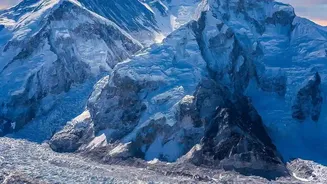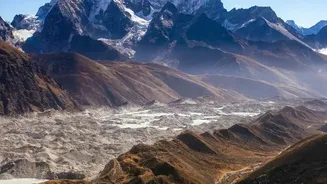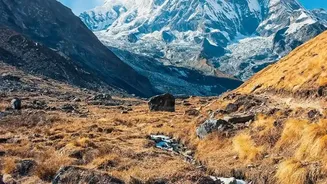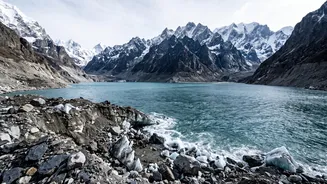







High in the Himalayas, melting glaciers are forming vast, unstable lakes, creating ticking time bombs that threaten millions. Recent United Nations reports sound the alarm on this growing danger, underscoring an urgent, unavoidable truth.
The Himalayan Ticking Time Bomb
Known as the
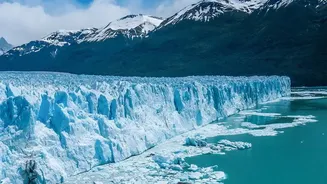
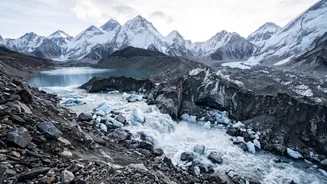
'Third Pole', the Hindu Kush Himalaya region contains the largest volume of ice outside the polar caps. But as global temperatures rise, these glaciers are melting at an accelerated rate. This meltwater pools behind natural dams of rock and debris left by retreating glaciers, forming what are known as glacial lakes. When these fragile dams breach, they unleash a catastrophic event called a Glacial Lake Outburst Flood (GLOF). These are not ordinary floods; they are sudden, violent torrents of water, ice, and debris that can travel dozens of kilometres, destroying everything in their path with little to no warning. Recent UN-backed reports indicate that the frequency of these events has surged, increasing by nearly five times since 1950. This makes understanding and mitigating GLOF risk a critical priority.
What the UN Is Warning
A series of recent reports from the UN and associated organisations paint a stark picture. Ahead of the COP31 climate summit, reports from the UN Environment Programme (UNEP) and the International Cryosphere Climate Initiative (ICCI) warn that the Himalayan region is warming much faster than the global average. For every 1.5°C of global warming, the Himalayas could see a rise of 1.8°C to 2.2°C. This accelerated warming is causing glaciers to retreat rapidly, leading to the formation of new and potentially dangerous glacial lakes. A joint report by the UNDP and the International Centre for Integrated Mountain Development (ICIMOD) identified 47 particularly hazardous lakes across Nepal, Tibet (China), and India. A separate UN-led study found that while China has the highest number of GLOF events, India has recorded the highest number of deaths, with over 6,000 fatalities between 1835 and 2025.
A Danger That Knows No Borders
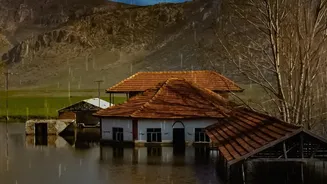
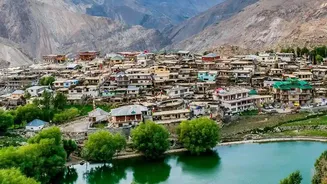
A GLOF is a threat that completely ignores political boundaries. A lake bursting in one country can have its most devastating impact downstream in another. For example, a recent GLOF from Sintaphu Lake in Bhutan triggered flood alerts across West Bengal and Assam in India. Studies show that China currently has the most transboundary lakes, with the potential to impact both India and Nepal. The interconnected river systems, like the Brahmaputra, Indus, and Ganga, mean that millions of people across India, Nepal, Bhutan, and Bangladesh are vulnerable to a disaster that originates hundreds of kilometres away in a different nation. This was tragically illustrated by a recent glacier collapse in Nepal near the Tibet border which caused a massive flood, claiming over 1,400 lives across both countries and leaving thousands more missing. This inherent transboundary risk is the central reason why a national-level approach is simply not enough.
The Call for a United Front
In response to these escalating threats, there is a growing chorus for a coordinated cross-border strategy. Following a devastating flood in August 2026, Nepal's Prime Minister called for a 'Himalayan Climate Resilience Mechanism' to unite Nepal, India, and China. Experts and UN agencies argue that such a framework is essential. A truly effective strategy would involve several key components: the formal, real-time sharing of hydrological and satellite data between nations; joint monitoring of the most dangerous glacial lakes; the development of integrated early-warning systems that can alert downstream communities across borders; and coordinated disaster response plans. Currently, data sharing is often limited or happens too slowly during an emergency, rendering it ineffective. Projects funded by bodies like the Green Climate Fund are already underway in Pakistan and Nepal to install early warning systems and lower the water levels in some high-risk lakes, but these are country-specific efforts.
Hurdles on the Path to Cooperation
The primary obstacle to a unified strategy is not scientific but political. The Himalayan region is one of the most geopolitically sensitive areas in the world, marked by longstanding territorial disputes between India and China. This friction creates a challenging environment for the kind of deep cooperation and trust required for effective disaster mitigation. Information that is vital for understanding climate risks, such as detailed topographical and hydrological data, can also have military applications, making governments cautious about sharing it. Building a framework that allows for the rapid, automated exchange of critical data without compromising national security is a monumental challenge. Despite these hurdles, there is a growing recognition that the shared threat of climate change may necessitate a new kind of diplomacy, one where environmental survival becomes a catalyst for collaboration.