

A Tiny Dot with a Big Secret
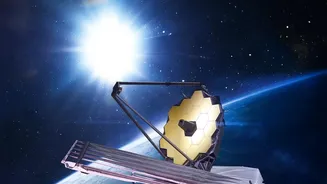
Since it began operations, the James Webb Space Telescope (JWST) has spotted a new class of objects that puzzled astronomers: small, compact, and very red sources from the early universe. Dubbed 'little red dots,' these objects appeared so bright and massive
for their cosmic age that some feared they might 'break' our standard models of cosmology. A new study focuses on one such dot, providing the clearest picture yet of what these objects truly are. What appeared at first to be an impossibly large galaxy in the infant universe is now understood to be something even more fascinating: a supermassive black hole growing at a furious pace, its light shrouded and reddened by a thick cocoon of gas and dust.
The Universe’s Most Powerful Engines
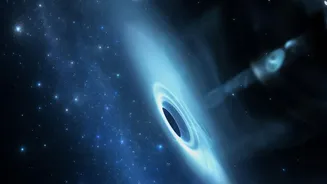
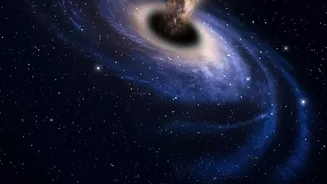
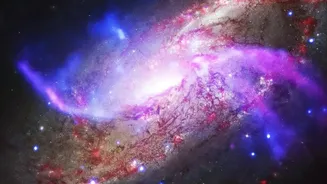
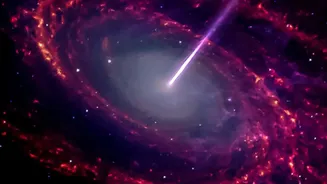
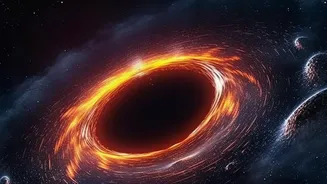
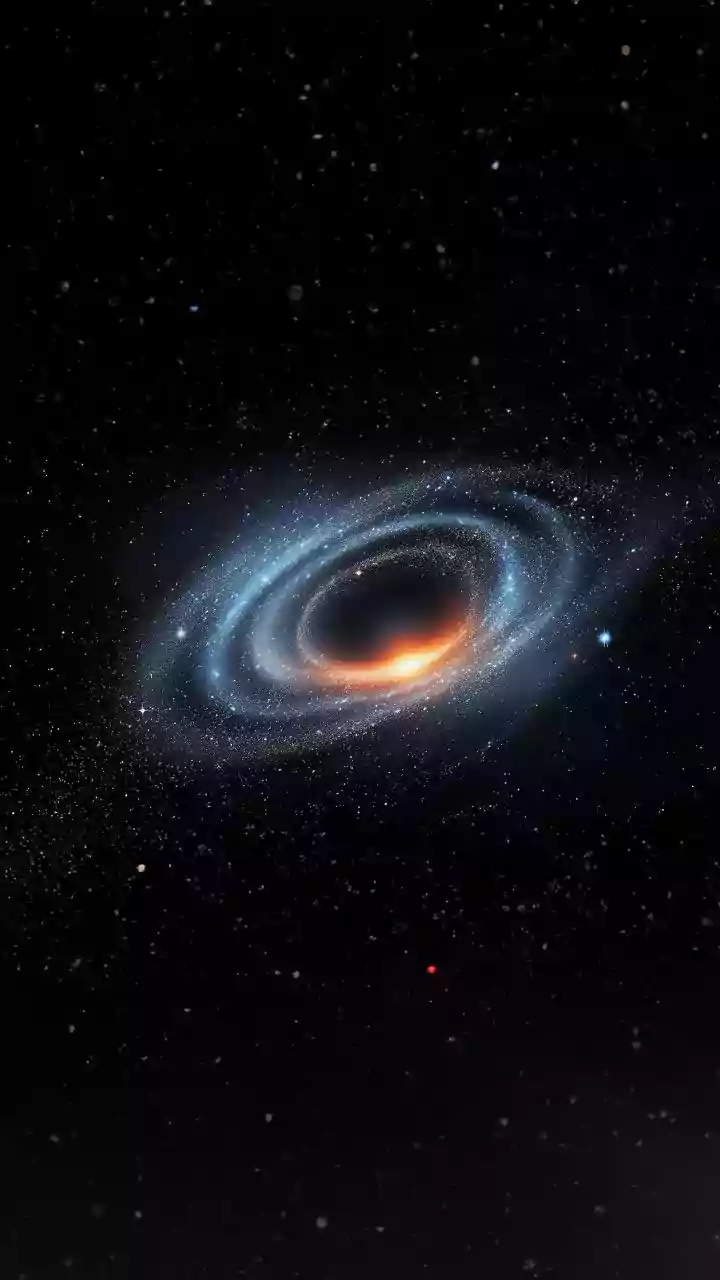
At the heart of most large galaxies, including our own Milky Way, lies a supermassive black hole. While most are dormant, about 5-10% are 'active'. An active black hole is one that is furiously consuming vast amounts of surrounding gas, dust, and stars. This material doesn't fall straight in; instead, it forms a swirling, superheated structure called an accretion disk. The friction and intense gravitational forces in this disk cause it to glow with unimaginable brightness, often outshining all the billions of stars in its host galaxy combined. These intensely luminous galactic cores are known as Active Galactic Nuclei (AGN), with the most powerful among them called quasars.
Peeking Through the Cosmic Dust
Previously, our models for understanding active black holes were complicated. Scientists believed that the appearance of an AGN depended heavily on our viewing angle. If we looked at it from the side, a thick, doughnut-shaped torus of dust would block our view of the central engine, making it look different than if we viewed it from above. However, the 'little red dots' didn't quite fit this model. They were bright, but also heavily obscured. The recent JWST study used its powerful infrared instruments to cut through the dust surrounding a specific 'little red dot.' It found that instead of a clumpy torus, the black hole was enveloped in a dense, spherical cocoon of gas. This simple but crucial difference is what makes the new findings so important.
A Simpler Model for Black Holes
The discovery suggests that these 'little red dots' may represent a specific, temporary phase in the life of a supermassive black hole. It’s an early, messy growth spurt where the black hole is feeding so intensely that it's enshrouded in its own fuel. This 'black hole star' model provides a much cleaner explanation for what we are seeing. It means we don't need to invent complex geometries or viewing angles to explain the observations. Much of the object’s light comes from the glowing, gas-shrouded black hole itself, not from a massive host galaxy of stars. This resolves the 'universe-breaking' problem; the galaxies aren't impossibly big, the black holes are just incredibly bright and hiding themselves in plain sight. This finding helps explain why many distant little red dots appear different from nearby active black holes, as thick dust can block much of the radiation.
The Next Chapter of Discovery
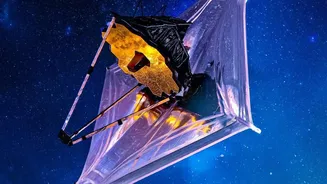
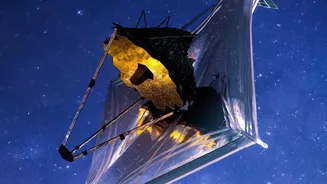
This new, simplified model doesn't just solve the riddle of the little red dots; it provides astronomers with a standard blueprint to better understand the early stages of black hole growth across the cosmos. By finding and studying more of these objects, scientists can piece together how the first supermassive black holes formed and grew so quickly after the Big Bang, a major outstanding question in astrophysics. It also showcases the revolutionary power of the JWST, which was specifically designed to peer into the dusty, distant corners of the early universe. Each observation adds another piece to the puzzle of our cosmic origins, and in this case, a tiny red dot has brought remarkable clarity to one of the universe's most chaotic and powerful phenomena.