



Meet the Sparkler Galaxy
Deep within one of the first spectacular images from the James Webb Space Telescope (JWST) lies a distant galaxy officially known as J1344, but more affectionately nicknamed 'the Sparkler'. Located some nine billion light-years away, we see this galaxy as it existed
when the universe was only about 4.5 billion years old. The galaxy earned its name from a smattering of compact, sparkling dots that surround its core. For years, using telescopes like the Hubble, these 'sparkles' were just faint, unresolvable smudges. But with the unprecedented power and sensitivity of the JWST, astronomers could finally see them clearly, unlocking a window into the cosmic past.
How Telescopes Become Time Machines
The concept of a telescope acting as a time machine is based on a simple, fundamental principle of physics: light takes time to travel. When you look at the Sun, you are not seeing it as it is right now, but as it was about eight minutes ago, the time it takes for its light to journey 93 million miles to Earth. This 'look-back time' gets much more extreme when we observe objects outside our solar system. The light from the Sparkler galaxy has been travelling for nine billion years to reach us. Therefore, when researchers point the JWST at it, they are capturing an image of the galaxy as it was nine billion years in the past. It’s a snapshot from the universe's adolescence, providing invaluable clues about how galaxies like our own Milky Way grew and evolved.
The 'Sparkles' are Cosmic Fossils
So, what are the mysterious sparkles that give the galaxy its name? Researchers analysing the JWST data determined that these bright knots are globular clusters — ancient, densely packed spheres of millions of stars. Globular clusters are like cosmic fossils. They are thought to contain the very first stars born in a galaxy's infancy. Our own Milky Way has about 150 of them, but because they are so old, it's difficult to precisely determine their age. By observing the Sparkler's clusters from a time when they were much younger, astronomers can more easily pin down their age and origin. Analysis confirmed these were some of the oldest globular clusters ever seen, having formed just 500 million years after the Big Bang.
Rewriting the Story of Galaxy Formation
This discovery has profound implications. Finding such mature, well-formed globular clusters so early in the universe's history challenges existing theories about the speed of galaxy formation. It suggests that the initial phases of star and galaxy assembly were perhaps more rapid and intense than previously believed. These early clusters are surprisingly 'chemically enriched,' meaning generations of stars had already lived, died, and seeded the environment with heavier elements. This detailed look at a galaxy's building blocks in the early universe helps scientists refine their models of cosmic evolution. It shows that galaxies may have begun building up their main structures much sooner than was thought possible.
A Boost from Nature's Magnifying Glass
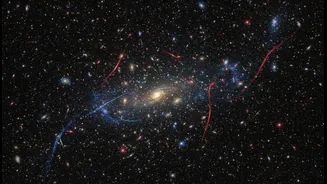
Observing such distant and faint objects would have been impossible without a helping hand from nature itself. The Sparkler galaxy is positioned behind a massive foreground galaxy cluster called SMACS 0723. The immense gravity of this cluster acts like a giant cosmic magnifying glass, bending and amplifying the light from the Sparkler by a factor of up to 100. This phenomenon, known as gravitational lensing, not only made the Sparkler visible but also created multiple images of it, allowing for a more detailed and robust analysis by the research team. It is this combination of a powerful telescope and a natural lens that has opened up this extraordinary view into the distant past.