


A Cosmic Crash in Stunning Detail
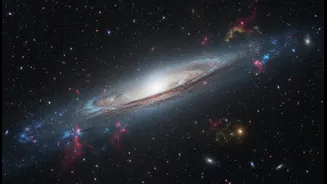
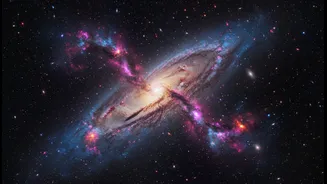
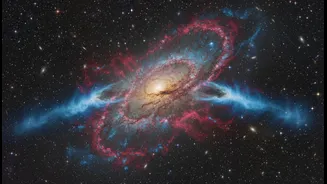
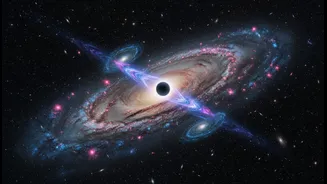
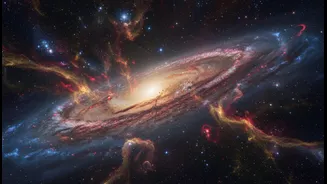
The new image of Centaurus A, located a relatively close 11 to 13 million light-years away, is unlike anything seen before. Previous telescopes, like Hubble, struggled to see past the thick bands of dust that scar the galaxy's center. But Webb's powerful
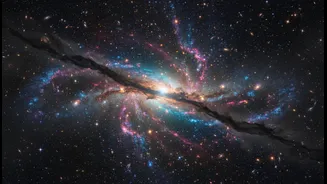
infrared instruments, MIRI and NIRCam, cut through the haze like a hot knife through butter. The result is a spectacular view of the galaxy's turbulent heart. What was once a dark, obscuring lane of dust is now revealed as a glowing, intricate structure of gas, with brilliant knots of reddish-purple that signify stellar nurseries where new stars are being born. The sheer level of detail is staggering; what looks like grainy texture is actually a dense field of millions of individual stars, each a tiny data point in a story billions of years old.
Meet the Peculiar Galaxy
Centaurus A has fascinated astronomers since it was first cataloged in the 1800s. It’s what’s known as a 'peculiar galaxy' because of its strange shape—it looks like a giant elliptical galaxy that has been wrapped in a dusty, distorted band. This unusual structure is the tell-tale sign of a dramatic past. Scientists believe that about two billion years ago, a large elliptical galaxy collided with and consumed a smaller spiral galaxy. This cosmic merger is responsible for the chaos we see today, providing the raw materials for intense star formation and feeding the supermassive black hole at its core.
Webb’s Infrared Superpower
This new image isn't just about pretty pictures; it’s a testament to the revolutionary technology of the JWST. While older telescopes like Hubble gave us sharp images in visible light, they were effectively blinded by the dust in Centaurus A's core. The retired Spitzer Space Telescope could see in infrared but lacked the power to resolve fine details. Webb provides the best of both worlds: the ability to see in infrared light that passes through dust, combined with a resolution so sharp it can distinguish individual stars in a galaxy millions of light-years away. This allows scientists to move from studying large-scale structures to performing galactic archaeology, tracing the galaxy's history star by star.
The Creative Power of Destruction
Galactic collisions, while sounding purely destructive, are a fundamental engine of cosmic creation and evolution. When galaxies merge, their gravitational forces compress huge clouds of gas and dust, triggering a massive burst of star formation known as a 'starburst'. The collision that formed Centaurus A dumped a massive amount of gas and dust into the galaxy, fueling the birth of new stars that we can now see glowing in Webb's image. This event also provided a fresh supply of material for the supermassive black hole at the galaxy's center, which weighs about 55 million times the mass of our sun. As the black hole feeds, it blasts out powerful jets of energy that further shape the galaxy around it.
What We Learn from the Chaos
Studying Centaurus A is like having a nearby laboratory for understanding some of the universe's most important processes. Because it’s so close and active, it's a perfect case study for how galactic mergers unfold and how they influence the growth of both galaxies and their central black holes. Webb's new data is already revealing surprising features, like a mysterious 'S' shaped structure near the core and warped disks of gas rotating around the black hole. By analyzing the light from millions of individual stars, scientists can create a timeline of the galaxy's evolution, pinpointing which stars formed before, during, and after the great collision. This detailed history helps us piece together the story of how all galaxies, including our own Milky Way, are built over cosmic time.