



Cosmic Detective Work
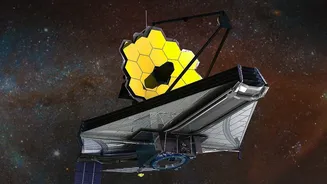
Imagine trying to figure out the composition of the air in a city thousands of kilometres away just by looking at one of its streetlights. It sounds impossible, but this is remarkably similar to how astronomers use the James Webb Space Telescope to find
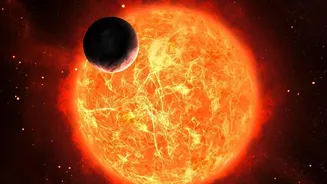
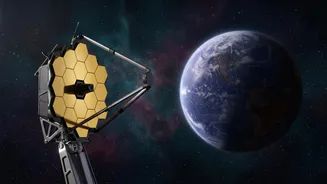
water on distant exoplanets. The technique is called transmission spectroscopy, and it’s a form of cosmic detective work. When a planet passes in front of its host star from our point of view—an event called a 'transit'—a tiny fraction of the starlight filters through the planet's atmosphere. That light carries with it a hidden message about the gases it encountered, which the incredibly sensitive instruments on the JWST can decode.
The Cosmic Barcode
At the heart of this method is a principle called spectroscopy. You’ve seen it in action when a prism splits white light into a rainbow. The spectrographs on the JWST do something similar, but far more precisely and in infrared light, which is invisible to human eyes. Every chemical element and molecule, including water (H₂O), absorbs very specific colours, or wavelengths, of light. This creates a unique pattern of dark lines in the star's rainbow-like spectrum, much like a barcode. The distinct pattern for water is its unmistakable 'fingerprint', telling scientists that it’s present in the planet’s atmosphere.
Webb’s Powerful Infrared Eyes
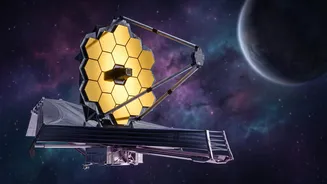
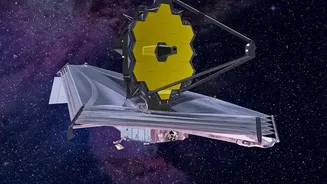
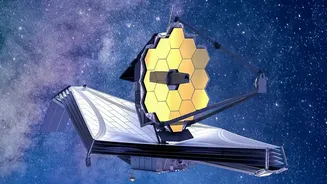
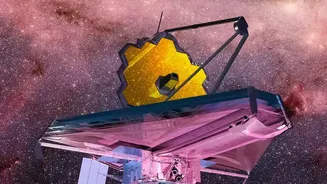
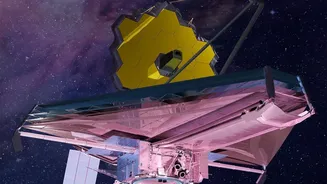
Detecting these faint barcodes of missing light is where the JWST truly excels. It is equipped with a suite of powerful instruments designed to capture and analyse infrared light, which is ideal for detecting molecules. Two key instruments are the Near-Infrared Spectrograph (NIRSpec) and the Mid-Infrared Instrument (MIRI). Together, they cover a huge range of infrared wavelengths where molecules like water, methane, and carbon dioxide leave their most prominent absorption signatures. When starlight passes through an exoplanet’s atmosphere, water vapour absorbs light at specific infrared wavelengths. NIRSpec and MIRI are sensitive enough to detect this dip in brightness, confirming water’s presence.
From Data to Discovery
The data doesn't arrive as a clear picture of a wet atmosphere, but as a graph showing the brightness of light at different wavelengths. Scientists analyse this graph, looking for the tell-tale dips that match the known absorption pattern of water. Recent discoveries, like the confirmation of water vapour in the atmospheres of planets like K2-18 b and WASP-80 b, showcase the power of this technique. In the case of K2-18 b, a potential 'Hycean' world, JWST not only found water but also methane and carbon dioxide, providing a more complete picture of its atmospheric chemistry. These findings are not just technical achievements; they are crucial steps in the search for potentially habitable worlds beyond our own.
More Than Just Water
The ability to detect water is just the beginning. The same spectroscopic method allows scientists to identify a whole host of other molecules that could hint at a planet's environment and potential for life. MIRI’s ability to probe the mid-infrared range is especially valuable for studying cooler objects and the building blocks of rocky planets. By analysing the complete atmospheric recipe—the presence and ratios of different gases—scientists can build a more detailed profile of these distant worlds. They can learn about a planet's temperature, atmospheric density, and even spot signs of chemical processes that might be driven by the star's light, a key factor in understanding its climate.