

For most of our lives, one number has defined the age of everything: 13.8 billion years. That's the consensus on how long our universe has existed. But what if that number was wrong? A new theory suggests our universe might be twice as old.
Our Universe's Standard Story
The prevailing
scientific narrative, known as the Lambda-CDM model, tells us the universe began with the Big Bang approximately 13.8 billion years ago. This model has been incredibly successful, explaining key cosmic features like the leftover heat from the Big Bang (the Cosmic Microwave Background) and the large-scale structure of galaxies. It relies on two mysterious ingredients: dark energy, an unseen force causing the universe to expand at an accelerating rate, and dark matter, an invisible substance whose gravity holds galaxies together. Combined, they are thought to make up about 95% of the cosmos, yet neither has ever been directly detected. This framework provides the foundation for how we calculate cosmic age by measuring the expansion of space.
The Problem of 'Impossible' Galaxies
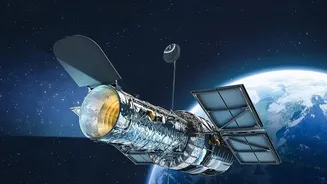
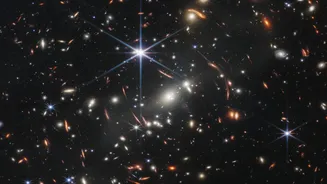
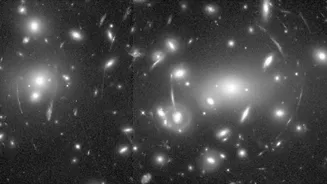
In recent years, NASA’s James Webb Space Telescope (JWST) has been peering into the deepest, earliest moments of the universe. What it found has puzzled scientists. The telescope has spotted galaxies that are far more massive and mature than they should be, given their age. Under the standard 13.8-billion-year model, some of these galaxies appear to have formed just 300 million years after the Big Bang, which doesn't seem to be enough time for them to evolve to such a complex state. This 'impossible early galaxy problem' has created cracks in the standard cosmological model, prompting some scientists to ask if a fundamental piece of the puzzle is missing.
A Radically Older Cosmos
Enter Rajendra Gupta, a physics professor at the University of Ottawa. He has proposed a new model that radically revises our cosmic timeline. His theory suggests the universe is actually 26.7 billion years old, nearly double the current estimate. This isn't just a random guess; it's part of a new framework called the CCC+TL model. The core idea is that if the universe is much older, those 'impossible' early galaxies suddenly have billions of extra years to form, making their advanced state entirely plausible. In Gupta's model, a galaxy we observe at a point in time when the universe was thought to be 300 million years old would actually be from an era when the universe was closer to 4.6 billion years old.
How This New Model Could Work
Gupta's model combines two unconventional ideas. The first is 'tired light' (TL), a century-old hypothesis proposed by Fritz Zwicky. It suggests that as light travels across billions of light-years, it gradually loses energy, making it appear redder. The current model attributes this 'redshift' purely to the expansion of space. Gupta suggests it could be a hybrid of both expansion and tired light. The second part of the model involves 'covarying coupling constants' (CCC). These are the fundamental forces of nature that govern how particles interact. The theory proposes that these constants might have changed over time. By weaving these ideas together, Gupta and his collaborator Nikolaos Samaras argue that they can explain cosmic phenomena without the need for dark matter or dark energy.
Awaiting the Scientific Verdict
It is crucial to understand that Gupta's CCC+TL model is a provocative new challenger, not the reigning champion. It stands outside mainstream cosmology, and the 'tired light' theory has been widely disputed in the past because it contradicted other observations. However, Gupta's work, published in journals like the Monthly Notices of the Royal Astronomical Society and Universe, claims to have successfully tested the model against several key cosmological observations, such as the amounts of elements created after the Big Bang and the rotation of galaxies. The scientific community remains cautious, and the model will need to withstand intense scrutiny and further testing before it can be considered a serious alternative to the standard model.