





The Ultimate Remote Work Site
Establishing a permanent human presence on the Moon is a core goal for space agencies like NASA and its international partners. But the biggest hurdle isn't just getting there; it's what to do once you arrive. Transporting building materials from Earth
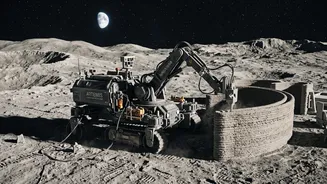
is incredibly expensive, so the future of lunar living depends on using what's already there. This strategy is called in-situ resource utilization (ISRU), and it's the driving principle behind lunar construction. The idea is to 'live off the land' by sending autonomous machines to do the heavy lifting. These robotic pioneers would arrive before astronauts to survey sites, prepare the ground, and begin building critical infrastructure like landing pads, roads, and shelters. By having robots perform these dangerous and repetitive tasks, human crews can focus on science and exploration when they arrive.
Robots, Regolith, and 3D Printers
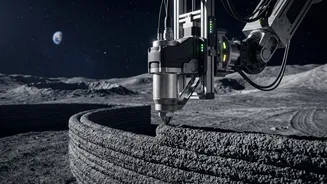
The key ingredient for lunar construction is regolith, the layer of fine, grey dust and rock fragments that covers the Moon's surface. The leading plan involves using this material as the basis for a kind of lunar concrete. Companies like ICON, in partnership with NASA on 'Project Olympus', are developing large-scale 3D printers that can turn this dust into durable structures. The process works by heating the regolith with powerful lasers, a technique known as sintering, which melts the particles together to form a solid, ceramic-like material layer by layer. Other methods being explored include mixing the regolith with a binding agent transported from Earth or stacking stones to form walls and domes. These robotic systems are being designed to operate with a high degree of autonomy, compensating for the communication delays between Earth and the Moon.
Building in a Hostile Environment
The Moon is an unforgiving construction site. There is no atmosphere to protect against meteoroids and intense solar radiation. Temperatures swing wildly from a scorching 127°C in the day to a freezing -173°C at night. And the lunar dust itself is a major hazard; it is abrasive, sharp, and electrostatically charged, causing it to cling to everything and wear down mechanical parts. Any habitat must be able to withstand these extremes. The designs being developed often feature thick, curved walls to offer protection from radiation and micrometeorite impacts. Some concepts propose building inside craters or burying habitats under several metres of regolith for natural insulation and shielding. These structures would serve as the first line of defense, creating a safe environment where astronauts can live and work.
What Will a Moon Base Look Like?
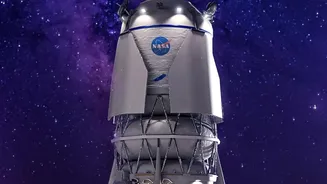
Early concepts for robotic construction often involve an inflatable module sent from Earth, which then serves as a scaffold. A robot would then 3D print a protective regolith shell over this inner structure. Architectural firms like Foster + Partners and BIG have partnered with space agencies to envision what these habitats might look like, such as the 'Lunar Lantern' concept developed with ICON. These aren't just bare-bones shelters; plans include laboratories, living quarters, and even social spaces and greenhouses to help humans not just survive, but thrive. The first structures to be built would likely be landing pads to prevent high-speed dust clouds during takeoffs and landings, followed by radiation shelters and, eventually, interconnected habitats that could grow into a sprawling lunar settlement.
The Dawn of a Lunar Economy
The goal of building on the Moon extends far beyond simply planting a flag. A permanent lunar outpost, such as the one NASA aims to establish at the Moon's South Pole, would be a crucial stepping stone for future missions to Mars and beyond. It would serve as a vital hub for scientific research, allowing for unparalleled astronomical observation and geological study. Furthermore, it lays the groundwork for a future lunar economy. With robots managing construction and maintenance, humans could focus on mining valuable resources, conducting experiments, and supporting commercial space ventures. By investing in robotic construction now, space agencies and their commercial partners are not just planning a mission; they are building the foundation for humanity's sustained future in the cosmos.