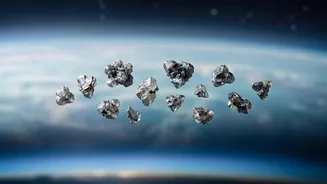






High above our heads, floating in the stratosphere, are microscopic visitors from the edge of the solar system. NASA has collected twelve tiny grains of dust believed to originate from the Kuiper Belt, giving us a precious glimpse into our cosmic past.
A Frontier of Ice and Rock
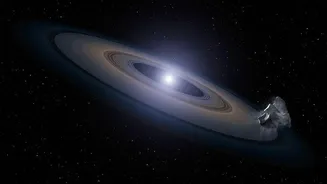
Beyond the orbit of Neptune lies the Kuiper Belt, a vast, doughnut-shaped ring of icy bodies. This distant and frigid region is populated by millions of frozen remnants from the formation of our solar system, including dwarf planets like Pluto. For scientists, the Kuiper Belt is a deep freeze of primordial material, a place where the building blocks of planets have remained relatively unchanged for billions of years. Objects within the belt occasionally collide, creating a spray of tiny dust particles. Over millions of years, forces like the solar wind can slowly push these grains toward the inner solar system, with some eventually making their way to Earth.
Fishing for Stardust
How do you catch a particle a thousand times smaller than a grain of sand? For decades, NASA has used high-altitude ER-2 aircraft to do just that. Flying in the thin air of the stratosphere, at altitudes up to 70,000 feet, these planes carry specially designed collectors under their wings. The collectors are coated with a sticky substance to trap interplanetary dust particles (IDPs) that have drifted down through the atmosphere. After a flight, the collectors are carefully removed and examined in an ultraclean laboratory at Johnson Space Center. Finding particles that originated from the Kuiper Belt among the terrestrial dust and micrometeorites from asteroids is a painstaking process, akin to finding a needle in a cosmic haystack.
The Significance of Twelve Grains
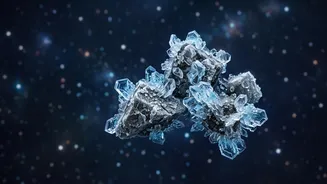
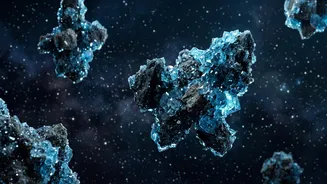
A recent analysis of twelve specific dust particles has provided compelling new evidence about the conditions at the edge of our solar system. Scientists identified these grains as originating from the Kuiper Belt by observing the high density of scars left by solar energetic particles, which indicates a very long journey through space. The examination revealed that the particles are largely composed of hydrated minerals—clays that form only when rock comes into contact with water. This provides direct evidence that liquid water was once present on the parent bodies of this dust, deep in the Kuiper Belt.
A Reservoir of Heavy Water
The discovery goes even further. Analysis of the minerals suggests that the water they formed in was rich in 'heavy' oxygen isotopes. This 'heavy water' contains more neutrons than the normal oxygen found in Earth's oceans. For years, scientists have theorized that a vast reservoir of this heavy water existed in the outer solar system, but evidence has been hard to find. These twelve tiny grains provide the first physical proof supporting that theory. The findings suggest this distant reservoir was largely isolated from the materials that formed the inner planets, making it a unique chemical environment.
Unlocking Solar System Secrets
Each speck of dust is a time capsule containing chemical clues about the raw materials that formed planets, including our own. By studying their composition, scientists can better understand the distribution of elements like carbon and organic matter across the early solar system. Some believe this type of dust could have delivered key ingredients for life to a young Earth. While the analysis of such minuscule samples is incredibly delicate—some techniques would destroy the precious grains—the potential payoff is enormous. These twelve particles are just the beginning, with ongoing missions like New Horizons continuing to measure dust even farther out, suggesting the Kuiper Belt may be even larger than we thought.