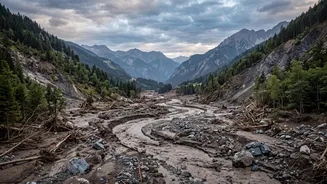







It Starts with Water, and Lots of It
The first ingredient is a flash flood. This isn't your typical river slowly rising over its banks. A flash flood is a rapid, intense deluge, often triggered by a cloudburst or extreme rainfall over a short period. In hilly regions, steep terrain acts
like a funnel, forcing rainwater to rush downhill at high speed instead of soaking into the ground. This happens especially when the soil is already saturated from previous rains or, conversely, when it's so dry and hard after a drought that it can't absorb water effectively. The result is a fast-moving torrent of water that courses through riverbeds and channels, gathering momentum as it descends.
The Key Ingredient: Loose Debris
A flash flood on its own is dangerous, but it's the addition of debris that changes the game entirely. Debris is simply any loose material the water can pick up. In mountainous areas like the Himalayas, this includes soil, silt, sand, gravel, and even massive boulders and uprooted trees. The landscape's condition is critical here. Geologically young and unstable mountains are naturally prone to erosion. Furthermore, human activities like deforestation and construction can leave slopes bare and unstable. Wildfires are another major factor; they burn away vegetation that holds soil in place and can even create a water-repellent layer on the ground, drastically increasing runoff and erosion.
The Tipping Point: From Flood to Flow
As the initial flash flood barrels down a slope, its erosive power scoops up this loose debris. This is the tipping point where the event transforms. The water doesn't just carry the debris; it mixes with it. The process is called 'bulking'. The volume and density of the moving mass increase dramatically as it incorporates more and more solid material. What started as mostly water becomes a thick, churning slurry that is often more than half solid material. This mixture, known as a debris flow, has the consistency of wet concrete and behaves very differently from water.
Why a Debris Flow is So Destructive
The immense destructive power of a debris flow comes from its density and momentum. A cubic metre of water weighs a tonne; a cubic metre of debris-laden slurry can weigh significantly more. Moving at speeds that can exceed 50 kilometres per hour, this mass carries incredible force. Unlike a flood of water, which flows around obstacles like buildings and bridges, a debris flow acts like a battering ram. It has enough power to smash through concrete structures, flatten forests, and bury entire villages under a thick layer of rock and mud. Because it's a dense liquid, it can also jump out of established river channels, carving new paths of destruction with little warning.
The Aftermath in Vulnerable Regions
In India, states like Uttarakhand and Himachal Pradesh, as well as parts of the Western Ghats, are highly susceptible to these devastating events. The combination of steep Himalayan topography, intense monsoon rains, and increasing ecological fragility creates a perfect storm. Recent disasters in the region have shown the catastrophic consequences, where entire settlements, roads, and critical infrastructure like hydropower projects have been wiped out in minutes. The solid material deposited by a debris flow can be metres deep, making rescue operations incredibly difficult and altering landscapes permanently by blocking rivers and creating new hazards.