



The Ultimate Logistical Challenge
Launching anything into space is a battle against gravity, and every kilogram counts. Water is incredibly heavy, and a crew on a multi-year mission to Mars would need a staggering amount. An astronaut requires roughly four litres per day for drinking,
hygiene, and rehydrating food. For a crew of four on a three-year round trip, this adds up to thousands of kilograms—an impossible amount to launch. Before advanced recycling, water made up nearly half the cargo on resupply missions to the International Space Station (ISS). For deep-space exploration where resupply is not an option, the only viable solution is to create a self-sustaining, or 'closed-loop', system. This is where advanced water recovery becomes less of a convenience and more of a fundamental necessity for survival.
The Life-Giving Machine
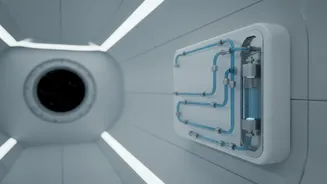
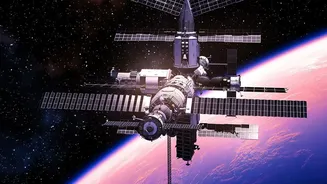
The heart of water recycling in space is the Environmental Control and Life Support System, or ECLSS. On the ISS, a key part of this is the Water Recovery System (WRS), which acts like a miniature municipal water plant, but far more sophisticated. It collects all forms of wastewater imaginable: urine, moisture from the crew's breath and sweat captured by dehumidifiers, and even condensation from the cabin walls. The goal is to purify this collected liquid to a standard that is often cleaner than the tap water we drink on Earth. It’s a combination of filters, chemical reactors, and distillation units working in concert to ensure the crew has a constant supply of safe, potable water, demonstrating the core principles needed for future missions.
From Wastewater to Drinking Water
The process sounds complex, but it's elegantly efficient. The system is split into two main parts: one that handles general wastewater and another that specifically tackles urine. The Urine Processor Assembly (UPA) uses a low-pressure vacuum to distill urine, separating water vapor from contaminants. This vapor is then condensed back into liquid. All the collected wastewater is then sent to the Water Processor Assembly (WPA). Here, it goes through a series of filters to remove particles and salts before a high-temperature catalytic reactor breaks down any remaining organic compounds. A final treatment adds iodine to prevent any microbial growth. The most recent breakthrough is the Brine Processor Assembly (BPA), which extracts even more water from the concentrated waste brine left over by the UPA, pushing the total water recovery rate to an incredible 98%.
A Game-Changer for Mars
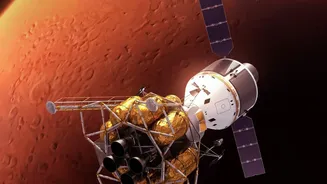
Achieving a 98% water recovery rate is a monumental step toward making a Mars mission feasible. For a journey that could last up to three years, a reliable, closed-loop life support system is non-negotiable. The less water and spare parts you have to launch, the more room you have for scientific instruments, habitats, and other critical supplies. Without this technology, the mass of the spacecraft required for a Mars mission would be too great for our current launch capabilities. New systems are already being tested on Earth in simulated Martian habitats to improve efficiency and reliability. The ultimate goal is to get as close to 100% recycling as possible, because over a long mission, even a small percentage of water loss can add up significantly.
The Next Frontier of Water Tech
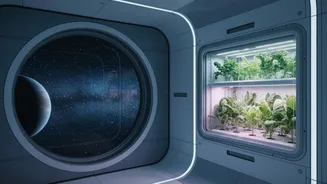
While the systems on the ISS are a proven success, engineers are already developing the next generation of water recovery technology. Research is focused on making the systems smaller, more reliable, and even more efficient. Innovations include new membrane technologies, advanced bioreactors that use microbes to treat waste, and systems that can process a wider variety of waste products. Another key area is reducing the need for maintenance and replacement parts, which would be difficult to manage millions of kilometres from Earth. Some future concepts even aim to integrate water recycling with food production by using the nutrient-rich byproducts to fertilize plants grown in space, creating a truly sustainable ecosystem for deep-space habitats.