





Setting the Stage for Success
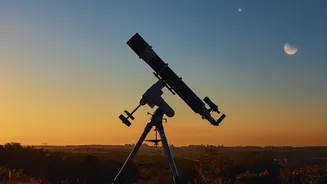
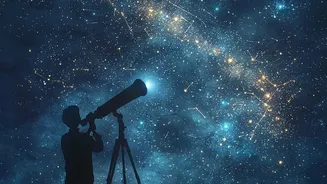
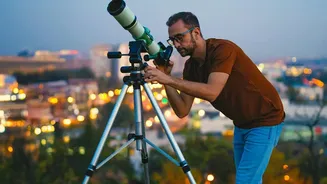
Before you can find your first star, you need to prepare. The best stargazing happens away from city lights, so find a park, a rural area, or even a dark corner of your backyard. Give your eyes at least 20 minutes to adjust to the darkness; this will
dramatically increase what you can see. A pair of binoculars is a fantastic first instrument—far more intuitive than a telescope. Also, consider downloading a stargazing app on your phone. These apps use your location to create a real-time map of the sky, making it easy to identify what you're looking at. Just be sure to switch to the red-light mode to preserve your night vision.
Saturn: The Ringed Jewel at Its Brightest
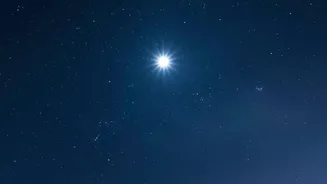
October 2026 is a banner month for Saturn. The planet reaches opposition on October 4, which means Earth is directly between it and the Sun. This alignment makes Saturn appear at its biggest and brightest for the entire year, visible all night long. Look for a steady, yellowish point of light rising in the east around sunset. While it's visible to the naked eye, even a basic pair of binoculars or a small telescope will give you a breathtaking view of its famous rings, which are once again visible after being nearly edge-on to us in 2025.
A Morning Dance of Planets
If you're an early riser, the predawn sky offers a beautiful planetary display. Throughout October, look to the eastern sky before sunrise to see reddish Mars and brilliant, white Jupiter getting closer to each other. On the morning of October 5, a crescent Moon will join them, creating a stunning trio. Mars will also do something special this month: on October 11, it will pass directly through the middle of the Beehive Cluster (M44), a collection of about 1,000 stars. This event will be a spectacular sight in binoculars, showing the red planet drifting against a backdrop of distant suns.
Connecting the Dots: Autumn's Key Constellations
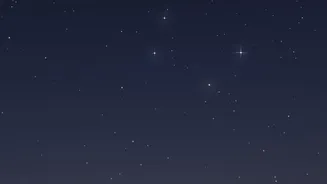
Finding constellations can feel daunting, but the key is to start with an obvious pattern. This month, look for the Great Square of Pegasus. It’s a large, easily recognizable box of four moderately bright stars, high in the eastern sky in the evening. Think of it as a celestial baseball diamond. Once you've found the Square, you can use it to navigate. Another easy-to-spot shape is the 'W' of Cassiopeia, a prominent constellation in the northern sky. In October, you can also still see the Summer Triangle—made of the bright stars Vega, Altair, and Deneb—high overhead in the evening.
A Glimpse of Another Galaxy
October is the perfect time to spot one of the most awe-inspiring objects in the night sky: the Andromeda Galaxy (M31). This is the closest major galaxy to our own Milky Way, containing a trillion stars. From a dark location, it is visible to the naked eye as a faint, fuzzy smudge of light. It’s bigger than you think—several times the width of the full moon—so don’t look for a pinpoint star. To find it, use the Great Square of Pegasus. Follow the line of stars arcing away from the square's northeast corner (a star named Alpheratz) to locate this distant island universe, 2.5 million light-years away.
October's Shooting Stars
The month hosts two meteor showers. First are the Draconids, which peak on the evening of October 8-9. This shower is best viewed right after sunset and is known for occasional outbursts, though it typically produces about 10 meteors per hour. The more famous Orionids peak on the nights of October 21-22. These meteors are debris from Halley's Comet and can produce up to 20 fast-moving streaks per hour. For the Orionids in 2026, the best viewing will be in the dark hours before dawn, after the bright Moon has set.