



A Laboratory in Our Backyard
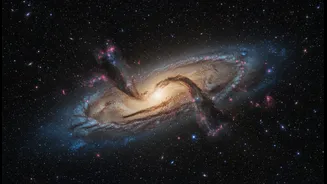
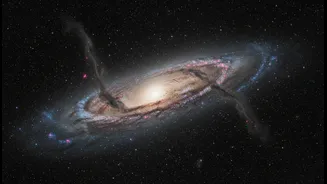
Centaurus A is one of the most studied objects in the southern sky for good reason. Located just 11 to 13 million light-years away, it's considered very close in cosmic terms. This galaxy is the result of a colossal collision between a large elliptical
galaxy and a smaller spiral galaxy about two billion years ago. The crash left behind a chaotic mix of gas, dust, and an unusual warped structure. At its heart lies an active supermassive black hole, furiously consuming material and blasting out powerful jets of energy. This combination of a recent merger, ongoing star formation, and an active black hole makes Centaurus A an ideal natural laboratory for understanding how galaxies evolve.
Seeing Through the Veil
Previous attempts to study the heart of Centaurus A were partially thwarted. The Hubble Space Telescope, which observes primarily in visible light, couldn't penetrate the thick bands of dust that obscure the galaxy's core. NASA's retired Spitzer Space Telescope could see in infrared but lacked the resolution to pick out individual stars or fine details. This is where Webb's utility shines. Its powerful near- and mid-infrared cameras cut through the cosmic dust with unprecedented clarity. What once appeared as a hazy glow is now revealed to be a densely packed field of millions of individual stars, allowing astronomers to see the galaxy's core star by star for the first time.
The Power of Galactic Archaeology
The ability to resolve individual stars turns this image into a tool for 'galactic archaeology'. By studying the different populations of stars, scientists can create a timeline of the galaxy's dramatic history. They can identify which stars existed before the collision, which were born during the violent merger, and which have formed since. This provides invaluable data for reconstructing the sequence of events over billions of years. The dust itself, now visible in exquisite detail, is the raw material for future generations of stars and planets, making its study crucial for understanding the galaxy's life cycle.
Decoding the Black Hole's Influence
Webb's new data also offers fresh clues about the complex relationship between a supermassive black hole and its host galaxy. The telescope's instruments can do more than just take pictures; they can analyze the light to measure how gas is moving. Early findings show fast-moving gas flowing outward, likely driven by the black hole's energetic jets. At the same time, a disk of warmer gas rotates near the center. This confirms a long-held theory: a black hole can both trigger star birth by compressing gas and quench it by blowing that same material out of the galaxy. Centaurus A provides one of the closest views we have of this cosmic balancing act.
New Mysteries to Solve
Like any great scientific instrument, Webb answers old questions while raising new ones. The mid-infrared view reveals intricate, glowing dust structures that perplex astronomers, including a mysterious S-shaped feature near the core. Scientists are not yet sure what created this structure; it could be a lingering effect of the ancient merger, a result of the black hole's influence, or a combination of both. These new puzzles ensure that the data from this single image will serve as a foundation for years of research, providing a roadmap for future studies of this fascinating galaxy.