
Capturing a Planet's Shadow
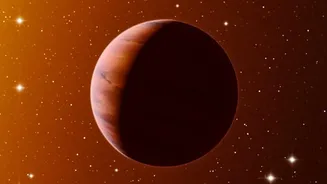
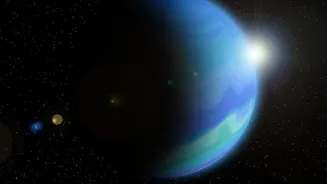
The entire process begins with an event called a 'transit'. This happens when an exoplanet passes directly in front of its host star from our point of view. As the planet transits, a tiny fraction of the starlight filters through the planet's atmosphere
before it reaches our telescopes. This light carries crucial information. At wavelengths where the atmosphere is opaque due to certain chemicals, the planet appears slightly larger, blocking more starlight. This subtle, wavelength-dependent change in the star's brightness is the key to everything that follows.
Reading the Light's Fingerprint
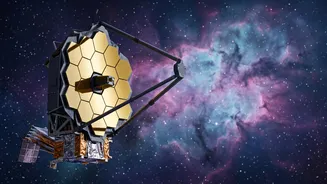
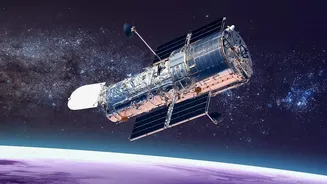
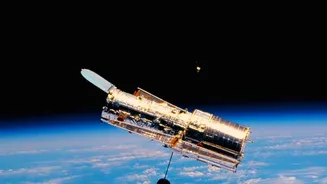
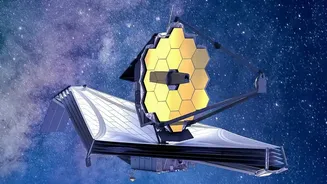
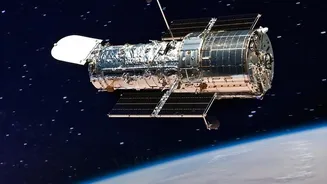
The light collected by a telescope like the James Webb Space Telescope (JWST) or Hubble is then broken down into its component colours, creating a spectrum. Different atoms and molecules in an atmosphere absorb light at very specific colours or wavelengths. This creates a unique pattern of missing light in the spectrum, which acts like a chemical fingerprint. Water, methane, carbon dioxide, and other compounds each have their own distinct absorption signature. By analysing which parts of the light spectrum are missing, astronomers can get a preliminary list of the ingredients present in the exoplanet's atmosphere.
Building Digital Atmospheres
Here's where the simulation comes in. Getting a simple list of chemicals isn't enough; scientists want to know their quantities, the atmospheric temperature, and pressure. To do this, they use powerful computer programs to build thousands, sometimes millions, of theoretical exoplanet atmospheres. These models, such as those developed at NASA, are digital twins of potential atmospheres. Scientists input different combinations of parameters: varying amounts of gases, different temperature and pressure profiles, and even the presence of clouds or hazes, which can significantly affect the data. Each simulated atmosphere produces a unique, theoretical spectrum.
The Search for a Perfect Match
This next step is a massive comparison game known as 'atmospheric retrieval'. The real spectrum gathered by the telescope—the one with the actual chemical fingerprints—is compared against the spectra from all the simulated atmospheres. Using sophisticated Bayesian statistical methods, computer algorithms search for the model that provides the best fit to the observational data. The process is computationally intensive, requiring complex algorithms to sift through the vast parameter space and find the most probable atmospheric model that explains what the telescope actually saw.
What the Match Reveals
When a close match is found, it's a moment of discovery. The parameters of the winning computer model are inferred to be the actual properties of the exoplanet's atmosphere. This allows scientists to go beyond simply saying "water is present" to quantifying how much water there might be. They can constrain the planet's temperature, determine if its atmosphere is clear or cloudy, and build a much more complete picture of this distant world. This detailed characterisation is what helps scientists assess factors like a planet's formation history and even its potential for habitability.