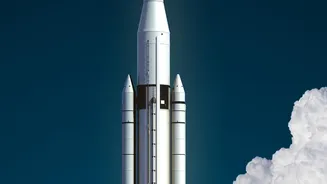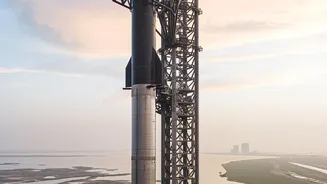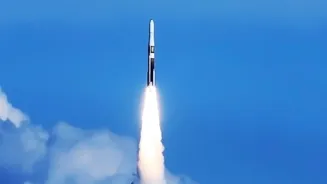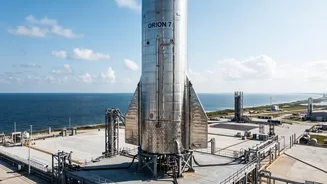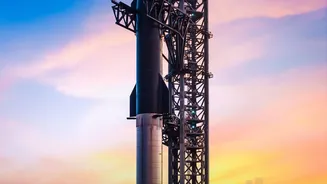



In a dramatic display of progress and peril, SpaceX's fifteenth Starship test flight saw a historic success and a fiery failure. While the booster was lost, the successful catch of the ship itself marks a pivotal moment for spaceflight.
A Launch of Mixed Fortunes
On Friday, November
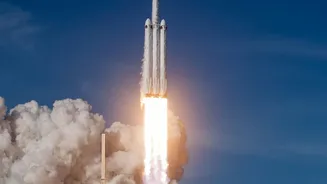
13, the world's most powerful rocket, Starship, ascended from its launchpad at Starbase, Texas, on its fifteenth test flight. The initial moments of the launch were flawless, with the 33 Raptor engines of the Super Heavy booster propelling the massive two-stage vehicle toward space. Following a successful 'hot-staging' maneuver, where the upper Starship stage ignited its own engines before separating, the mission's two components went their separate ways. The Starship, known as Ship 42, continued its journey, successfully reaching orbit for only the second time in the program's history. It then spent the next 22 hours in space, where it deployed 26 next-generation Starlink satellites before preparing for its ambitious return to Earth.
The Booster's Fiery Setback
While the Starship upper stage performed perfectly, the Super Heavy booster did not share its success. The plan was for the booster to perform a flip maneuver, fire its engines to fly back to the launch site, and be caught by the giant mechanical arms of the launch tower. However, the booster's guidance, navigation, and control system detected an issue, reportedly related to low fuel mass, and automatically aborted the catch attempt. It diverted itself for a controlled landing burn over the Gulf of Mexico, but its flight termination system was triggered upon engine shutdown, resulting in the booster's destruction. This setback means SpaceX has yet to achieve its goal of recovering both stages on a single flight.
A Landmark Catch for Starship
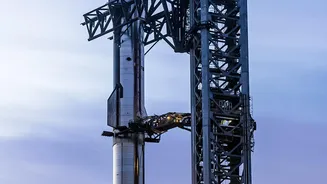
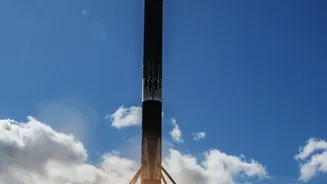
The loss of the booster was quickly overshadowed by the stunning success that followed a day later. After completing 14 orbits of Earth, the Starship vehicle began its intense, high-speed reentry through the atmosphere. On Saturday, November 14, it navigated itself back to Starbase, performing a final 'belly-flop' maneuver before reigniting three Raptor engines to flip upright and slow its descent. In a moment that looked like science fiction come to life, the launch tower's massive arms, nicknamed 'Mechazilla', closed around the 171-foot-tall spacecraft, catching it securely hundreds of feet above the ground. This was the first time any orbital-class upper stage had ever been recovered this way, a feat never before attempted in the history of rocketry.
Why Full Reusability is the Holy Grail
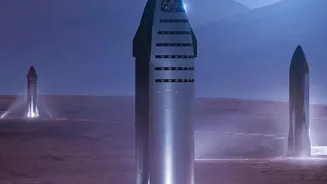
The significance of this successful catch cannot be overstated. It is the core of Elon Musk's vision for making humanity a multi-planetary species. Traditional rockets are expendable, meaning the most expensive parts are discarded after a single use. SpaceX's smaller Falcon 9 rocket pioneered booster reuse, dramatically lowering launch costs. Starship aims to take this a giant leap further by making the entire system fully and rapidly reusable. Being able to launch, recover, and quickly relaunch both the booster and the ship could slash the cost of accessing space by orders of magnitude. This is the key that unlocks the possibility of building bases on the Moon, cities on Mars, and deploying massive satellite constellations for global internet and other services.
What Comes Next for SpaceX
With the successful recovery of a Starship, SpaceX has proven that the most difficult part of its reusability plan is achievable. Engineers will now inspect Ship 42 to assess its condition after its trip to orbit and fiery reentry, with Musk suggesting it could fly again within weeks. The primary challenge now shifts back to consistently recovering the Super Heavy booster, a feat the company has accomplished on previous flights but failed to repeat this time. Future test flights will focus on perfecting the 'double catch'—recovering both stages at the launch tower. Achieving this would finally demonstrate the complete reusability that Starship was designed for, moving the program from the experimental phase into a new era of operational spaceflight for NASA's Artemis moon missions and beyond.