






A World of Constant Surprise
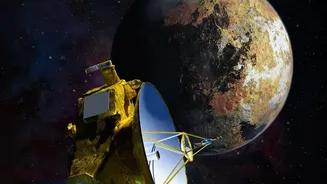
When NASA’s New Horizons spacecraft sped past Pluto in 2015, it beamed back images that fundamentally changed our understanding of the dwarf planet. Instead of a cold, dead, and cratered block of ice, we saw vast nitrogen glaciers, towering water-ice
mountains, and a surprisingly complex atmosphere. The initial data was a treasure trove, but the discoveries didn't stop there. More than a decade later, scientists are still meticulously combing through the high-resolution imagery and data, using advanced modeling and fresh perspectives to uncover clues that were hidden in plain sight. As New Horizons principal investigator Alan Stern recently noted, “Pluto never stops surprising us.” Recent findings published in 2026 underscore this, suggesting that Pluto’s surface has been, and may still be, shaped by processes that challenge our assumptions about cold, distant worlds.
Evidence of Recently Flowing Liquid
Perhaps the most startling recent discovery is evidence of recently flowing liquid on Pluto’s surface. A new analysis of images from the northern edge of Sputnik Planitia—the vast, heart-shaped nitrogen glacier—shows dark features that strongly suggest liquid nitrogen has welled up from beneath the surface. Published in the Planetary Science Journal in August 2026, the study points out that while Pluto's thin atmosphere makes liquid nitrogen rain impossible, the patterns are strikingly similar to areas on Earth's glaciers wetted by subsurface liquid. Computer models support this, indicating that nitrogen ice at the base of Sputnik Planitia's kilometers-deep glacier could melt under pressure, forming liquid nitrogen that then seeps up through cracks. This finding marks the first evidence of recent, and possibly ongoing, liquid flows on Pluto, painting a picture of a world with a dynamic subsurface.
The Mystery of the Bladed Terrain
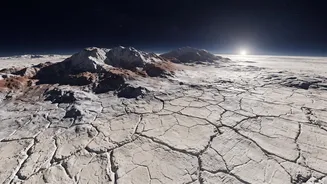
Another area of intense focus is Pluto’s mysterious “bladed terrain,” particularly the jagged ridges of Tartarus Dorsa. These towering spires of methane ice, some reaching hundreds of feet high, are unlike anything else seen in our solar system. For years, their formation was a puzzle. However, ongoing analysis suggests these features are sculpted by long-term climate cycles. At high altitudes, methane freezes out of the atmosphere, creating massive ice deposits. Over vast timescales, as Pluto’s orbit brings it slightly closer to the Sun, this methane ice doesn't melt but sublimates—turning directly from a solid into a gas. This erosional process carves the ice into the dramatic, blade-like formations we see today. Furthermore, recent photometric analysis suggests this bladed terrain may not be confined to the hemisphere New Horizons imaged up close, but could be a global phenomenon, hinting at planet-wide climate processes.
Landslides on an Icy World
Adding to the evidence of Pluto's dynamic surface, researchers recently identified the first definitive signs of landslides. A 2026 study published in the journal Icarus detailed six massive landslides found along the steep inner walls of impact craters. These weren't minor slips; the debris aprons stretched for miles across the crater floors, indicating highly efficient movement, likely aided by low friction from the icy materials and Pluto's low gravity. The triggers for these events remain a mystery—possibilities include tectonic activity or subsequent meteoroid impacts—but their very existence proves that Pluto’s surface is actively changing. These landslides, combined with the evidence of flowing liquid and atmospheric cycles, portray Pluto not as a static relic, but as a living world, geologically speaking.