






A World That Refuses to Freeze
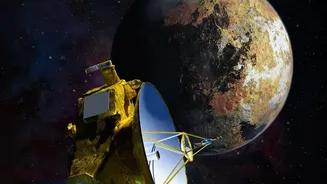
When NASA's New Horizons spacecraft flew past Pluto in 2015, it completely rewrote our understanding of this remote world. Instead of a simple, cratered ball of ice, the probe revealed towering water-ice mountains, vast plains of frozen nitrogen, and a stunning
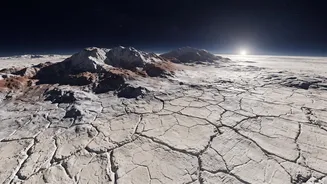
lack of craters in some areas, suggesting the surface was geologically young and active. Now, a fresh analysis of that very same data provides the most tantalising evidence yet: signs that liquid nitrogen may have recently seeped onto Pluto’s surface. This discovery, published in the Planetary Science Journal, centres on the iconic heart-shaped region known as Tombaugh Regio. Specifically, it focuses on the western lobe, a massive nitrogen glacier called Sputnik Planitia. Researchers noticed dark features along the boundaries of large, city-sized convection cells of ice, which look remarkably similar to patterns made by meltwater on Earth's own ice sheets. This points to the possibility of liquid welling up from below.
What 'Liquid' Means on Pluto
Liquid on Pluto is not what we would typically imagine. With surface temperatures plummeting to around minus 230 degrees Celsius, liquid water is impossible. Instead, scientists believe we are seeing liquid nitrogen. Models show that the sheer weight of the kilometres-deep Sputnik Planitia glacier could generate enough pressure and trap enough internal heat to melt the nitrogen ice at its base. This liquid nitrogen could then be forced up through cracks and fissures, temporarily wetting the surface before freezing again. This isn't the only sign of recent geological turmoil. Scientists have also identified several massive cryovolcanoes—ice volcanoes—such as the enormous Wright Mons. This mountain, roughly 150 kilometres across, has very few impact craters, indicating its surface was formed relatively recently in geological terms. The theory is that a subsurface slurry of water, ammonia, or other ices erupted onto the surface, building these giant structures. Researchers have even found evidence of massive landslides, further proof that Pluto is a dynamic and evolving world.
The Engine of a Hidden Ocean
So what could be powering all this activity? The leading hypothesis is that Pluto harbours a vast liquid water ocean beneath its thick ice shell. While this might sound contradictory on such a cold world, scientists believe Pluto's rocky core contains enough heat-producing radioactive elements to have melted a layer of its ice shell long ago. The presence of ammonia, which acts as an antifreeze, could also help keep this ocean in a liquid, albeit syrupy, state. The New Horizons data supports this idea. Instead of finding evidence of global shrinkage, which would occur if an ocean had frozen solid, the spacecraft found large extensional faults—giant cracks showing the surface has been stretching. This expansion is a key sign that a subsurface ocean is, at the very least, in the process of slowly freezing, causing the surface to expand and crack. Some models even suggest Pluto had a "hot start," forming rapidly enough to trap heat and maintain a liquid ocean from its very beginning.
A Deepening Cosmic Mystery
Every new discovery from Pluto seems to add another layer to its complexity. Once dismissed as a minor, inert body—and famously demoted from planet status—it has emerged as one of the most fascinating and active worlds in the outer solar system. The evidence for liquid nitrogen flows, cryovolcanic activity, and a potential subsurface ocean forces scientists to rethink the conditions under which a celestial body can remain geologically alive. Pluto never stops surprising us, as Alan Stern, the principal investigator for the New Horizons mission, has repeatedly stated. This latest hint of recent liquid suggests that time-variable features may exist on its surface, meaning the Pluto we see today could look different from the Pluto of a million years ago, or a million years from now. It serves as a powerful reminder that even the coldest, most distant corners of our solar system hold dynamic secrets, waiting to be uncovered.