




The Cosmic Shadow Play
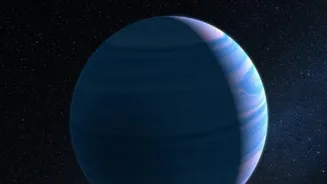
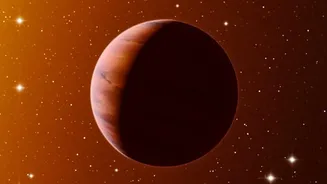
To find water hundreds of light-years away, astronomers use a clever technique called transmission spectroscopy. It relies on a specific alignment: a distant planet, known as an exoplanet, must pass directly in front of its host star from our point of view.
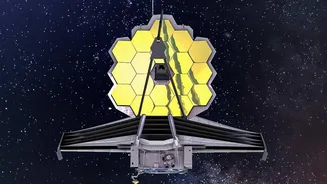
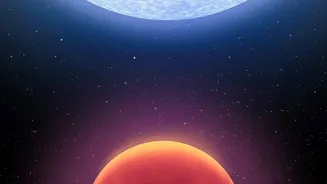
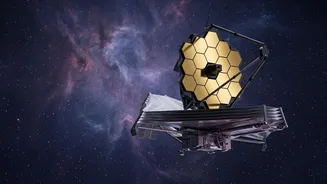
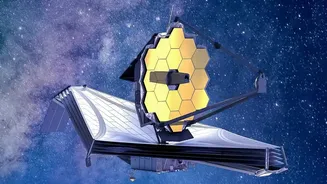
This event is called a transit. As the planet transits, a tiny fraction of the star's light filters through the planet’s atmosphere. The molecules present in that atmosphere absorb some of this light, casting a sort of chemical shadow. It is within this shadow that the secrets of a world’s composition are hidden. The James Webb Space Telescope is specifically designed to capture and decode this incredibly faint light, turning that shadow into a readable story.
Splitting Light to Find Clues
The core technology at play is spectroscopy, the science of breaking light down into its component colours, or wavelengths. Think of how a prism splits sunlight into a rainbow; a spectrometer does something similar but on a much more sophisticated scale and for infrared light, which is invisible to the human eye. Every chemical element and molecule has a unique “fingerprint”—it absorbs very specific wavelengths of light. When astronomers spread the starlight into a full spectrum, they can see which wavelengths are missing. These missing pieces, called absorption lines, act as a cosmic barcode, telling scientists exactly which chemicals are present in the exoplanet’s atmosphere.
Webb’s Specialised Infrared Eyes
The JWST is equipped with a suite of powerful instruments, but two are particularly crucial for this task: the Near-Infrared Spectrograph (NIRSpec) and the Mid-Infrared Instrument (MIRI). NIRSpec examines the near-infrared part of the spectrum, a range rich with the signatures of many key molecules. MIRI looks at longer, mid-infrared wavelengths, which is ideal for studying cooler objects and detecting different molecular fingerprints. These are not ordinary cameras. They are incredibly sensitive devices that must be kept extremely cold—MIRI operates at a frigid 7 degrees above absolute zero—to prevent their own heat from interfering with the faint infrared light from distant stars. Together, they provide a comprehensive view across a wide band of infrared light.
The Unmistakable Signature of Water
So, how does this reveal water? Water vapour (H₂O) molecules are very effective at absorbing specific wavelengths of infrared light. When the starlight passes through an atmosphere containing water, these molecules trap that specific light, preventing it from reaching the telescope. As NIRSpec and MIRI build the spectrum, they see significant dips at precisely the wavelengths where water is known to absorb light. It’s not just one dip, but a distinct pattern of them. When scientists see this exact pattern, they can confidently confirm the presence of water vapour in that distant world’s atmosphere, even from billions of kilometres away.
From Data to Discovery
This method has already yielded spectacular results. Using its spectrometers, the JWST has successfully detected water vapour in the atmospheres of numerous exoplanets. For example, it found clear evidence of water in the atmosphere of a 'sub-Neptune' planet called TOI-421 b. In another landmark discovery, it helped confirm that the planet GJ 9827 d is a 'steam world,' with an atmosphere composed almost entirely of water vapour. Even more profoundly, Webb detected water in the planet-forming disk of dust and gas around a young star named PDS 70. This suggests that the essential ingredients for life are available from the very beginning of a solar system’s formation.