





From Splashdown to De-Servicing
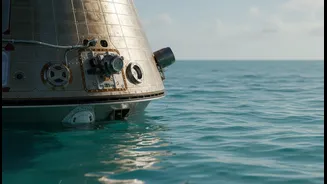
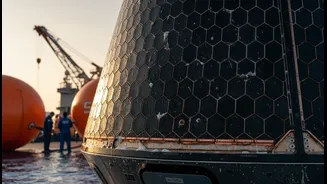
The moment the Orion capsule splashes down in the Pacific Ocean, a highly coordinated recovery operation begins. U.S. Navy teams, positioned in advance, will secure the spacecraft and help the four astronauts exit safely. After initial medical checks
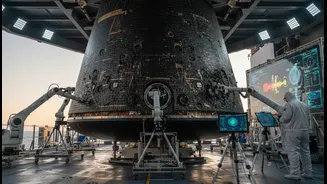
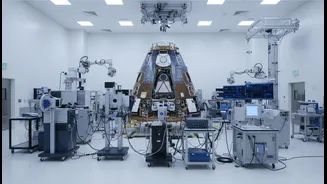
aboard the recovery ship, the crew will return to Houston for debriefing and reunion with their families. The Orion capsule, meanwhile, begins its own important journey. It will be carefully transported back to NASA's Kennedy Space Center in Florida. There, in the Multi-Payload Processing Facility, it undergoes a meticulous process called de-servicing. Technicians will remove any remaining hazardous materials, like fuel and ammonia, and retrieve time-sensitive science experiments and data logs. This careful disassembly is the first step in a deep-dive analysis that determines the success of the mission and the safety of those that will follow.
The Heat Shield: Orion's Fiery Trial
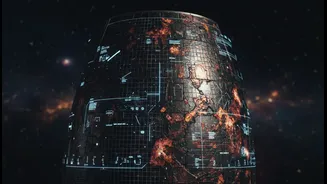
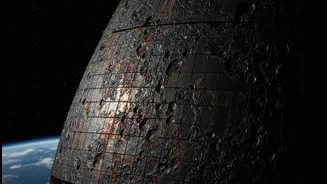
A primary focus of post-flight analysis will be the heat shield. During its return, Orion will slam into Earth's atmosphere at around 40,000 km/h, generating temperatures of nearly 2,800 degrees Celsius. After the uncrewed Artemis I mission, engineers discovered that the heat shield's ablative material, which is designed to char and wear away, did so in unexpected ways. More than 100 locations showed unexpected "char loss." While the capsule was never in danger, understanding this phenomenon became a top priority. For Artemis II, engineers will meticulously inspect the heat shield, correlating sensor data with detailed imagery taken during re-entry to validate their new models and confirm the system performed as expected, ensuring the crew was protected. This intense scrutiny is vital for clearing the spacecraft for Artemis III, which will land astronauts on the Moon.
A Treasure Trove of Sensor Data
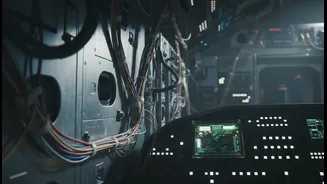
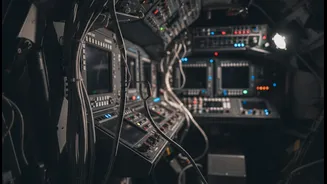
The Orion spacecraft is packed with thousands of sensors, each gathering crucial information. During Artemis I, these sensors generated gigabytes of data on everything from the performance of the European Service Module, which provided 20% more power than expected, to the deployment of the parachute systems. For Artemis II, this data collection is even more critical because it includes the human element. Data from the crew's seats will measure the g-forces, acceleration, and vibrations experienced during launch, re-entry, and splashdown. This information helps engineers understand the physical stresses on the astronauts and fine-tune the systems for a smoother, safer ride on future, longer missions.
The Unseen Threat: Measuring Radiation
Beyond low Earth orbit, astronauts are exposed to a much harsher radiation environment, including galactic cosmic rays and unpredictable solar flares. Artemis II serves as a critical test bed for measuring this exposure. Building on data from Artemis I, where instruments like the Hybrid Electronic Radiation Assessor (HERA) and manikins named Helga and Zohar measured radiation levels, Artemis II will provide the first data with actual crew. The four astronauts will wear monitors, and sensors throughout the cabin will record radiation levels in real-time. Scientists will analyze blood and saliva samples from the crew to see how deep space changes the human immune system. This data is essential for validating radiation shielding strategies and developing procedures, like using onboard stowage to create a makeshift shelter during a solar storm, to protect astronauts on the long journey to Mars.
Validating Systems for the Lunar Landing
Every piece of data collected from Artemis II feeds directly into the planning for Artemis III and beyond. The post-flight checks are a comprehensive validation of Orion's life support, navigation, communication, and propulsion systems in a real-world, crewed environment. Engineers will check every component, from reused avionics to the performance of the crew's suits. The lessons learned from Artemis I, which had issues like damage to the launch tower and unexpected power circuit trips, were incorporated into Artemis II. Likewise, the full data set from Artemis II's flight will give NASA the confidence to certify Orion for its next, most ambitious task: delivering astronauts to a landing system that will take them to the lunar surface. It's a process of turning data into safety, and flight tests into a roadmap for humanity's future in deep space.