

The Sun's Volatile Temper
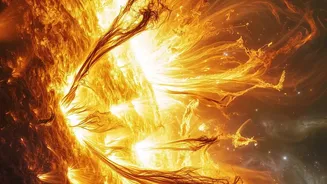
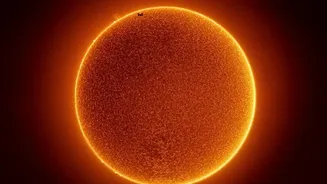
Our reliance on technology makes us vulnerable to the Sun's violent outbursts. Solar flares, which are massive explosions of radiation, can reach Earth in just eight minutes, disrupting radio communications. Even more impactful are Coronal Mass Ejections
(CMEs), enormous clouds of magnetised plasma and charged particles that travel through space and can slam into Earth's magnetic field days after leaving the Sun. A severe geomagnetic storm, the likes of which was seen during the 1859 Carrington Event, could have catastrophic consequences today. It could induce currents powerful enough to overload and destroy electrical power grids, potentially leading to widespread, long-lasting blackouts. The threat extends to satellites, which are susceptible to damage to their electronics, and GPS systems, which can suffer from degraded accuracy.
A Global Network of Watchtowers
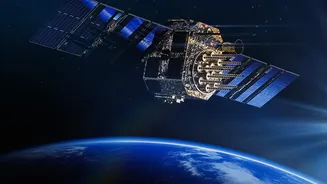
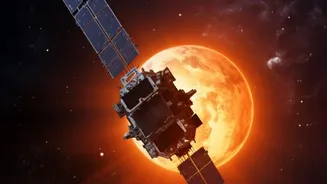
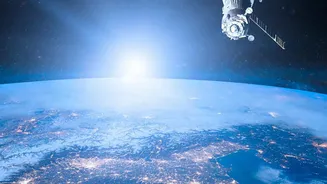
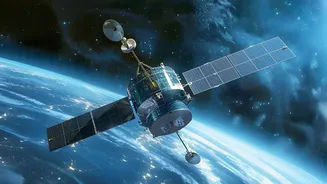
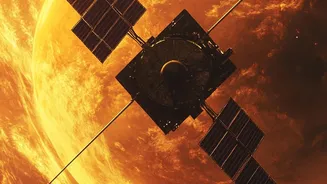
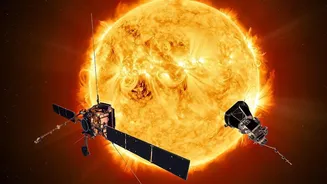
To counter this cosmic threat, a sophisticated and global network of eyes constantly monitors the Sun. This system is a combination of space-based observatories and ground-based instruments. In space, satellites operated by agencies like the US National Oceanic and Atmospheric Administration (NOAA) and NASA provide an uninterrupted view of solar activity. Observatories placed at a special point in space called Lagrange point 1 (L1), about 1.5 million kilometres from Earth, act as crucial early-warning sentinels. They can detect the solar wind and CMEs heading our way. On the ground, a worldwide network of solar telescopes, radio spectrographs, and magnetometers track sunspots, solar radio bursts, and changes in Earth's magnetic field, adding vital data to the global picture. This international collaboration is essential, with entities like the European Space Agency (ESA) and China's Meridian Project contributing significant resources.
From Data to Actionable Forecasts
All this raw data flows to forecast centres around the world, most prominently NOAA's Space Weather Prediction Center (SWPC) in the United States. The SWPC, operating jointly with the U.S. Air Force, acts as the official source for space weather alerts and warnings for the nation and a key hub for the world. Forecasters there analyse the stream of information from satellites and ground stations, much like meteorologists forecasting terrestrial weather. They use complex computer models, like the WSA-Enlil model, to predict the arrival time and intensity of solar wind and CMEs. Based on this analysis, the SWPC issues watches, warnings, and alerts on a scale from minor to extreme, giving governments and critical industries lead time to prepare.
The Planetary Defence Plan
When a significant space weather warning is issued, a well-rehearsed, though largely unseen, defense plan swings into action. Power grid operators can take preventative measures like reducing load or redirecting power flows to protect their transformers from damaging induced currents. Satellite operators might power down non-essential systems or reorient their spacecraft to minimise exposure to harmful radiation. Airlines that fly routes over the polar regions, where Earth's magnetic protection is weaker, may reroute flights to lower altitudes to protect crew, passengers, and communication systems from increased radiation. Even GPS-dependent industries, from agriculture to aviation, receive alerts allowing them to anticipate and manage potential signal inaccuracies. This proactive response is crucial for mitigating the worst effects of a solar storm and ensuring the resilience of our technological backbone.