






What Is Rath Yatra?
Rath Yatra, or the Chariot Festival, is one of India's most significant and visually stunning religious events. It commemorates the annual journey of Lord Jagannath, his brother Lord Balabhadra, and his sister Devi Subhadra from their home in the Jagannath Temple
to the Gundicha Temple, said to be their aunt's residence. For nine days, the deities reside there before making the return journey. The festival's core principle is one of profound inclusion; it is the one time of year the deities leave the temple's inner sanctum to be seen by everyone, regardless of caste or creed, making it a powerful symbol of equality and divine love. An estimated one to two million people descend on Puri to witness this event, a testament to its immense cultural and spiritual pull.
The Centrepiece: Puri's Grand Procession
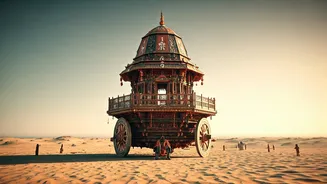
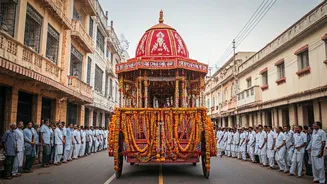
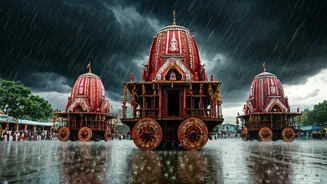
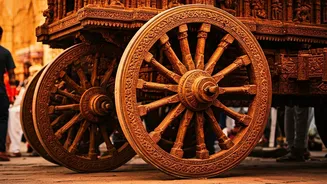
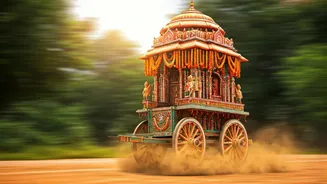
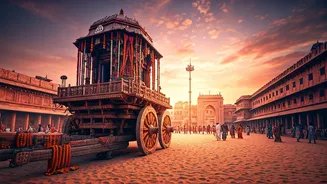
The main event unfolds on the Bada Danda, the grand avenue of Puri in Odisha. In 2026, the main procession will take place on Thursday, July 16. The festival's highlight is the three colossal wooden chariots, which are newly constructed every year by skilled artisans. Lord Jagannath’s chariot, Nandighosa, stands about 45 feet tall with 16 wheels. Lord Balabhadra's, Taladhwaja, is 44 feet with 14 wheels, and Devi Subhadra’s, Darpadalana, is 43 feet with 12 wheels. On the day of the yatra, after a series of rituals including the 'Chhera Pahara' where the Gajapati King of Puri sweeps the chariot platforms with a golden broom, thousands of devotees take hold of thick coir ropes to pull the massive structures. This collective act of pulling the chariots is considered an act of great merit, uniting millions in a single purpose.
A Traveller's Guide to Attending
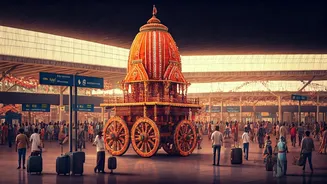
Attending Rath Yatra requires planning, as Puri becomes extremely crowded. It is advisable to book accommodation and travel months in advance. Arriving a day or two early can help you acclimatise and navigate the town before peak crowds arrive. The weather in July is typically hot and humid, so lightweight cotton clothing is recommended. For a safer and more comfortable viewing experience, find a spot along the barricaded zones or wider sections of the Grand Road rather than pushing into the dense crowds near the moving chariots. Many hotels and guesthouses offer rooftop access for a bird's-eye view. Remember to carry essentials like water, a hat, and an ID, but avoid bringing valuables. While non-Hindus cannot enter the main Jagannath Temple, the entire street festival is open to all.
More Than a Single Day
While the main procession on July 16th is the main draw, the festival is a multi-week affair with several key rituals. It begins with Snana Purnima (the bathing ceremony) weeks earlier. The return journey, known as Bahuda Yatra, is on July 24, 2026, and is just as vibrant but sometimes less crowded. A particularly spectacular event is Suna Besha on July 25, 2026, when the deities are adorned with elaborate gold ornaments while still on their chariots. This 'Golden Attire' is a breathtaking sight witnessed by hundreds of thousands. The festival concludes with Niladri Bije, the deities' return to the temple's inner sanctum.
Celebrations Beyond Puri
While Puri hosts the world's largest and most famous Rath Yatra, the festival is celebrated with great fervour across India and the globe. Ahmedabad in Gujarat hosts the country's second-largest procession, with a unique atmosphere featuring decorated elephants and martial arts performers. Kolkata and Mahesh in West Bengal also have historic and vibrant celebrations. In recent decades, the festival has gone global, with large chariot processions organised by ISKCON and other Hindu communities in cities like London, New York, San Francisco, and Sydney, bringing the spirit of Jagannath to a worldwide audience.