




The Coolest Science in Orbit
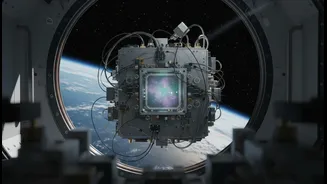
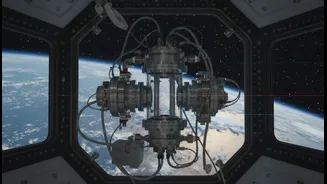
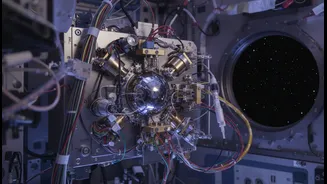
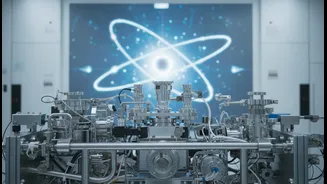
The Cold Atom Laboratory, or CAL, is a mini-fridge-sized instrument that launched to the International Space Station in 2018. Its mission is to do something seemingly paradoxical: create temperatures a billionth of a degree above absolute zero, far colder
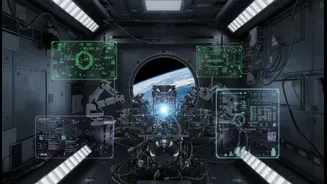
than the depths of outer space itself. By using a combination of lasers and magnetic fields, scientists on Earth can remotely manipulate clouds of atoms like rubidium and potassium inside CAL's vacuum chamber. The first step involves using precisely tuned lasers to slow the atoms down, which dramatically cools them. Then, magnetic traps confine the atomic cloud, allowing for further cooling until the atoms are brought to a near-complete standstill. This process allows for the study of quantum phenomena in ways that are simply not possible on the ground.
Creating a Fifth State of Matter
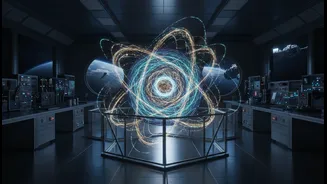
The purpose of reaching these extreme temperatures is to create a unique state of matter called a Bose-Einstein Condensate (BEC). Predicted in the 1920s based on the work of Indian physicist Satyendra Nath Bose and Albert Einstein, a BEC forms when a group of atoms, known as bosons, become so cold and slow that their individual quantum natures blur. Instead of behaving like a chaotic crowd of individual particles, they begin to act in unison, like a single, massive 'super atom'. In this state, the strange rules of quantum mechanics, which are normally confined to the subatomic realm, become visible on a macroscopic scale. CAL was the first facility to successfully produce Bose-Einstein Condensates in Earth orbit, a major milestone for physics.
Why Go to Space to Get Cold?
Creating a BEC is possible in labs on Earth, but there's a fundamental problem: gravity. As soon as the atoms are cooled and released from their magnetic trap for observation, gravity pulls them down. This gives scientists only a fraction of a second to perform any measurements. In the microgravity of the ISS, however, the atom cloud simply floats. This allows for observation times of up to 10 seconds. This extended duration is a game-changer. It allows the matter waves to expand and evolve without disturbance, enabling much more precise measurements and even the creation of novel geometries, like ultracold atomic bubbles, that would collapse under their own weight on Earth. This unique environment is critical for probing the fundamental nature of quantum mechanics.
The Promise of Precision Sensing
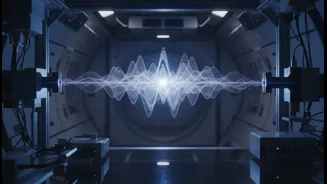
The ability to observe and manipulate BECs in microgravity is the key to unlocking the technology of atom interferometry. This technique takes advantage of the wave-like nature of the super-chilled atoms. A BEC is split, sent along two different paths, and then recombined. Any tiny difference in the forces experienced along these paths—such as a minute change in gravity or acceleration—will create a measurable shift in the interference pattern when the waves merge back together. Because the atoms are so cold and their wave-like properties are so pronounced, these sensors can be made exceptionally sensitive. It's a technology that promises to measure gravity, time, and motion with a precision far beyond what is currently possible.
From Space to Real-World Impact
While the research on CAL sounds like fundamental science, the potential applications are profoundly practical. Atom interferometers could lead to next-generation navigation systems for aircraft and ships that don't rely on GPS signals, which is crucial in denied environments. On Earth, these ultra-precise gravity sensors could be used for geological surveys, helping to locate underground water reserves, mineral deposits, or even monitor volcanic activity. Further into the future, this research could impact fields like quantum computing and fundamental physics, helping us test Einstein's theory of general relativity or even search for dark matter. The Cold Atom Lab is not just a science experiment; it's a technology incubator for the next quantum revolution.