





The Old Way vs. The New Way
For as long as humanity has sent probes to other planets, we have relied on radio waves to talk to them. This method, known as radio frequency (RF) communication, has been a reliable workhorse for NASA's Deep Space Network. However, it has a fundamental
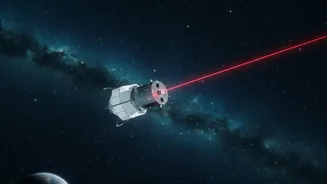
limitation: bandwidth. As our scientific instruments become more powerful, they generate massive amounts of data—high-resolution images, complex geological scans, and atmospheric readings. Squeezing this data through the narrow pipeline of RF is incredibly slow. It could take weeks or months to transmit a full map of Mars back to Earth. Enter optical communications. Instead of radio waves, this technology uses near-infrared laser light to send and receive information. Because light waves are much more tightly packed than radio waves, they can carry vastly more data. This is the difference between sending a single text message and streaming a 4K movie. The successful demonstration of this technology, called Deep Space Optical Communications (DSOC), has proven it can deliver data rates 10 to 100 times higher than the best RF systems currently in use.
Anatomy of a Laser Call Home
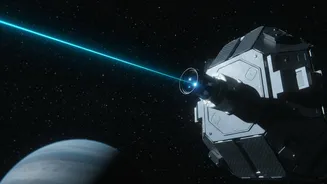
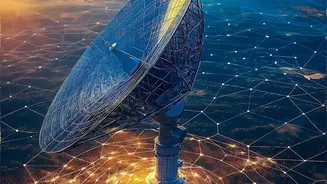
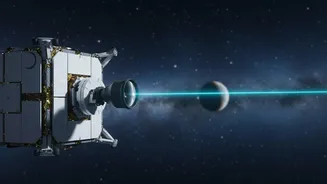
So, how does a spacecraft make a laser call from millions of miles away? The process, demonstrated by the DSOC experiment aboard NASA's Psyche spacecraft, is a marvel of precision engineering. It begins with an uplink. A powerful laser transmitter at a ground station, like the one at NASA's Table Mountain facility in California, fires a near-infrared laser beam into space. This beam doesn't carry much data; its primary job is to act as a beacon, guiding the spacecraft's targeting system. The DSOC transceiver on Psyche, which features an 8.6-inch telescope, locks onto this faint beacon to calculate its aim. Once locked on, the spacecraft fires back its own powerful downlink laser. This beam is encoded with data—turning digital bits into pulses of light. This faint signal travels across the vastness of space for minutes, or even hours, to reach its destination: the 200-inch Hale Telescope at Caltech's Palomar Observatory. There, an array of incredibly sensitive superconducting nanowire detectors counts the individual photons, reconstructing the data and decoding the video or scientific telemetry sent from the probe.
Hitting a Moving Target
The greatest challenge is the incredible pointing accuracy required. Imagine trying to hit a moving coin from a kilometer away with a laser pointer—now scale that up to interplanetary distances. Both the spacecraft and Earth are hurtling through space, so the laser must be aimed not at where Earth is, but where it will be when the light arrives minutes later. The DSOC system uses sophisticated pointing and isolation assemblies to steady the beam and compensate for tiny vibrations from the spacecraft itself. Another hurdle is Earth's own atmosphere. Clouds and turbulence can easily scatter the laser beam, disrupting the signal. To minimise this risk, NASA chose high-altitude observatory locations known for their clear skies. Despite these challenges, the DSOC demonstration was a resounding success. In December 2023, it famously streamed a high-definition video of a cat named Taters from 19 million miles away, achieving a stunning bitrate of 267 megabits per second—faster than many home internet connections.
Paving the Way for a High-Bandwidth Solar System
The successful conclusion of the DSOC project in late 2025 marked a pivotal moment for space exploration. The technology didn't just work; it surpassed all expectations, transmitting data from distances greater than Mars is from Earth. The implications are enormous. Future missions to the Red Planet could send back daily high-definition video, allowing scientists on Earth to virtually explore the landscape alongside rovers and astronauts. Human crews on long journeys to Mars would have a high-speed data link, enabling real-time communication, telemedicine, and the exchange of large data files essential for mission safety and success. Furthermore, the hardware for laser communications is significantly smaller, lighter, and more power-efficient than comparable radio systems. This saves precious mass and energy on spacecraft, allowing for more scientific instruments or a longer mission life. It opens the door for a future where the entire solar system is connected by a high-speed internet of sorts, accelerating the pace of discovery and bringing the farthest reaches of space closer to home.