





A Unique Earthly Perspective
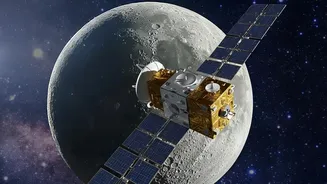
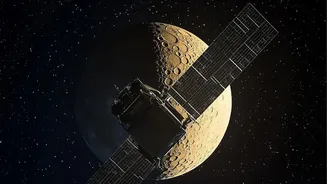
Aboard the Chandrayaan-3 mission's Propulsion Module was a unique, experimental payload called SHAPE, which stands for Spectro-polarimetry of Habitable Planet Earth. Unlike the lander and rover, which focused on the Moon's surface, SHAPE's sole purpose
was to point itself at our home planet. As the spacecraft journeyed towards the Moon and settled into lunar orbit, SHAPE had the rare opportunity to observe Earth from a great distance, watching it as a single, integrated point of light, much like how we see distant exoplanets. This ingenious experiment was designed by scientists at ISRO's U. R. Rao Satellite Centre to leverage the mission's trajectory for a secondary, but profoundly important, scientific goal.
Using Earth as the Ultimate Cheat Sheet
To find a habitable planet light-years away, scientists first need to know exactly what they're looking for. Earth is our only confirmed example of a life-bearing world, making it the perfect test subject. The main goal of SHAPE was to treat Earth as if it were a newly discovered exoplanet. By measuring the specific characteristics of the sunlight reflecting off our planet, SHAPE gathered data on the tell-tale 'biosignatures' that indicate a habitable environment. This includes the chemical fingerprints of gases in our atmosphere and the way light interacts with surfaces like oceans, clouds, and continents. This data acts as a template or a reference guide, helping astronomers to distinguish a potentially Earth-like world from a barren rock when they analyze the faint light coming from distant star systems.
Decoding the Language of Light
The SHAPE instrument is a spectro-polarimeter, a device that analyzes two key properties of light. Firstly, spectroscopy splits light into its constituent wavelengths, creating a spectrum, much like a prism creates a rainbow. When sunlight passes through Earth's atmosphere and reflects off the surface, certain gases absorb specific wavelengths of light, leaving dark lines in the spectrum. These absorption lines act as a barcode, revealing the presence of molecules like water vapour, carbon dioxide, and oxygen—all crucial for life as we know it. Secondly, polarimetry measures the orientation of the light waves. As light bounces off different surfaces—for instance, a smooth ocean versus a rough landmass or fluffy clouds—its polarisation changes. This can provide invaluable clues about a planet's surface features and cloud cover, which spectroscopy alone cannot easily determine.
Building a Blueprint for Discovery
By combining spectroscopy and polarimetry, SHAPE gathered comprehensive data on Earth's 'disc-integrated' signature—the combined light from the entire visible face of the planet. The instrument captured these signatures in the near-infrared wavelength range (1.0 to 1.7 micrometres) from various phase angles, observing Earth as it rotated and its appearance changed from crescent to gibbous, just like the Moon appears to us. This creates a rich dataset that models how a living planet's light signature evolves. This detailed blueprint is crucial for designing and interpreting data from future, more powerful telescopes, like the proposed Habitable Worlds Observatory. When these observatories one day stare at a pale blue dot orbiting a distant star, the data collected by SHAPE will provide the vital context needed to interpret whether that dot could be another Earth.