


What Are Air-Breathing Electric Systems?
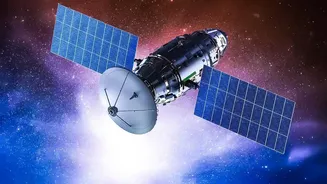
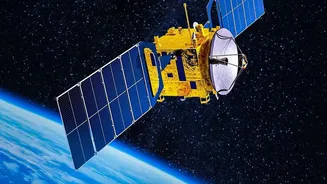
An Air-Breathing Electric Propulsion (ABEP) system is a revolutionary concept designed to keep satellites in orbit indefinitely without carrying their own propellant. Traditionally, satellites in low orbits must fire thrusters to counteract atmospheric
drag, a process limited by the amount of chemical propellant or inert gas, like xenon, they can carry. ABEP systems work by scooping up the sparse molecules of atmospheric gases present even at high altitudes, using a specially designed intake. These collected particles—mostly nitrogen and oxygen—are then used as the propellant for an electric thruster. The concept effectively allows a satellite to 'breathe' the very air that causes orbital decay, turning a problem into a solution.
How Does It Actually Work?
The process is elegant in its simplicity, though technologically complex. As a satellite orbits at high speed, a passive intake funnel collects the residual atmospheric particles. These particles are channelled into a thruster where they are ionized, meaning they are given an electric charge. An electromagnetic field then accelerates these newly created ions and ejects them at high velocity, generating thrust. This thrust counteracts the atmospheric drag that would otherwise pull the satellite back to Earth. The entire system is powered by solar arrays, making it a sustainable solution for long-term missions as long as the satellite has power and its components remain functional.
The Very Low Earth Orbit Advantage
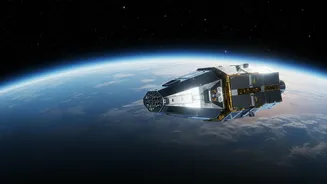
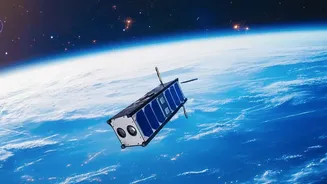
This technology is a game-changer for satellites operating in Very Low Earth Orbit (VLEO), an altitude range roughly between 150 and 400 kilometres. Operating closer to Earth offers immense benefits: Earth observation satellites can capture much higher-resolution images, and communication satellites can provide lower latency and stronger signals. However, the denser atmosphere in VLEO creates significant drag, causing rapid orbital decay for conventional satellites. ABEP technology directly solves this by providing continuous drag compensation, enabling persistent, long-duration missions in this valuable orbital region for the first time. Furthermore, VLEO is a more sustainable orbit; at the end of a mission, a satellite will naturally deorbit and burn up, reducing the long-term problem of space debris.
The Dawn of a New Satellite Era
The implications of moving away from onboard chemical propellants are profound. Launch mass is a primary driver of cost in the space industry. By eliminating the need for heavy propellant tanks, satellites can be lighter and cheaper to launch, or the saved mass can be allocated to more advanced sensors and payloads. Missions that were previously impossible due to fuel limitations, such as long-term atmospheric studies or persistent surveillance, become feasible. While ABEP systems produce low thrust compared to chemical rockets, their incredible efficiency and limitless fuel source make them ideal for maintaining orbit over many years. They won't replace powerful rockets for launch, but they will redefine what's possible once a satellite is in orbit.
Who Is Leading the Innovation?
Several international space agencies and private companies are racing to perfect this technology. The European Space Agency (ESA) has been a pioneer, successfully test-firing a prototype in 2018 in collaboration with Italian company SITAEL and Polish firm QuinteScience. Japan's Aerospace Exploration Agency (JAXA) is also actively developing its own Air-Breathing Ion Engine (ABIE). In the commercial sector, companies like Phase Four have received contracts from DARPA to develop ABEP systems for defense applications. Other startups, including Viridian Space and the Ahmedabad-based Orbitt Space, are also developing their own versions of this technology, signalling a vibrant and competitive new market for sustainable space operations.