

Beyond the Galactic Plains
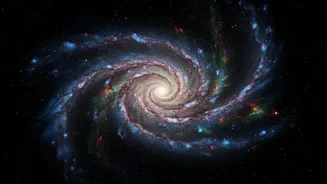
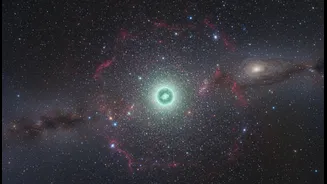
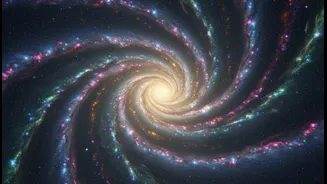
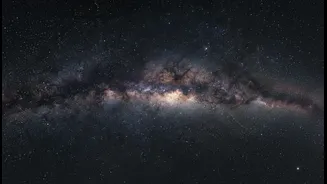
For decades, our model of the Milky Way has been relatively neat: a flat, spinning disk of stars and gas where we reside, a dense central bulge, and a vast, mostly empty spherical halo surrounding it all. This picture was elegant but incomplete. Astronomers
long suspected there was more lurking in the darkness of the halo, the galaxy's enormous, diffuse attic. Now, thanks to revolutionary new tools, we are finally seeing the ghosts that haunt our galactic home, and they are changing everything we thought we knew.
Rivers of Ghostly Stars
The most profound revelations come from the discovery of dozens of 'stellar streams' crisscrossing the Milky Way's halo. These are not stars born within our galaxy but the shredded remains of smaller dwarf galaxies and ancient star clusters that strayed too close. Pulled apart by the Milky Way's immense gravity over billions of years, their stars were stretched into long, flowing ribbons that now orbit within our halo like cosmic breadcrumbs. This process, often called 'galactic cannibalism', is evidence that our galaxy grew, and continues to grow, by devouring its smaller neighbors. The most famous example, the Sagittarius Stream, wraps around the Milky Way entirely, a spectral reminder of an ongoing meal.
The Gaia Revolution
Uncovering these faint, ethereal structures would be impossible without the European Space Agency's Gaia spacecraft. Launched in 2013, Gaia has been on a mission to create the most precise three-dimensional map of our galaxy ever attempted. By meticulously tracking the positions, movements, and distances of over a billion stars, Gaia has given astronomers the data needed to spot the subtle, coordinated movements that betray the presence of a stellar stream. Discoveries that once happened by chance are now being made systematically, revealing a halo teeming with the debris of past collisions and mergers. Gaia's data has shown that much of our galaxy's inner halo is populated by stars from a single, massive collision with a galaxy dubbed Gaia-Sausage-Enceladus that occurred around 10 billion years ago.
A True Galactic Ecosystem
This new evidence forces a dramatic shift in perspective. The Milky Way is not a solitary, static island of stars. It is the dominant hub of a complex and interconnected stellar ecosystem. This system includes the main galaxy, dozens of smaller satellite galaxies orbiting it, the flowing stellar streams that connect them, and a vast, churning reservoir of gas called the circumgalactic medium that acts as the galaxy's fuel source, waste dump, and recycling plant. Just like a biological ecosystem, these components are in a constant state of interaction. Gas flows from the halo to form new stars in the disk, stars explode and enrich that gas with new elements, and entire galaxies are consumed, their stars and dark matter being incorporated into the larger structure.