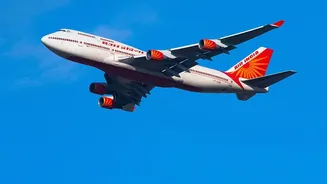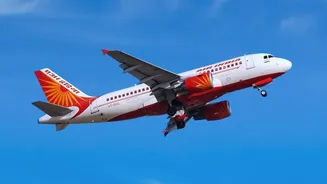








For a few tense hours, Air India flight AI2030 was at the center of a major security alert. An automated hijack signal sent security agencies scrambling, but the threat wasn't real. The incident has now sparked an investigation into its cause.
A Scare at 30,000 Feet
On October
14, Air India flight AI2030, a Boeing 787-9 travelling from Frankfurt to Delhi with 293 passengers and 13 crew members, was abruptly diverted. While flying in the Mumbai Flight Information Region, an alert was triggered that suggested a possible hijacking. Following strict security protocols, air traffic controllers instructed the aircraft to divert to Jaipur International Airport. The plane landed safely and was immediately moved to an isolation bay, where it was met by security personnel, including the Central Industrial Security Force (CISF) and local police. Passengers, who were initially told the diversion was for security reasons, were deplaned and underwent another round of security checks before the all-clear was given.
What is a 'Hijack Code'?
The alert was triggered by a transponder code: 7500. In aviation, a transponder is a device that broadcasts a flight's identity, altitude, and other data to air traffic control (ATC). Pilots are assigned a unique four-digit 'squawk' code for their journey. However, there are universal emergency codes, and 7500 specifically signals 'unlawful interference', or a hijacking. When ATC receives this code, the aircraft's icon on their radar screen immediately changes, often turning red, and an alarm sounds. This initiates a non-negotiable security response on the ground, regardless of whether voice communication with the pilots confirms a threat. The protocol is designed to assume the worst to ensure maximum safety.
The Unconfirmed Technical Cause
So, what went wrong on flight AI2030? While early speculation pointed toward a pilot accidentally entering the code, this has been largely disputed. Pilots and airline officials have reportedly stated that the crew did not squawk 7500. Entering the code requires manually punching in four separate digits, making an accidental entry highly improbable, with one senior pilot calling it a 'one in a trillion' chance. Instead, the investigation is now focusing on a potential technical malfunction on the ground. Suspicion has fallen on a newly installed ATC radar system in Mumbai, which may have erroneously generated the hijack alert. The Directorate General of Civil Aviation (DGCA) is leading the probe to determine if the fault lay with the ground system rather than the aircraft.
Protocols, Procedures, and Passenger Experience
Once the 7500 code was detected, a well-defined chain of events unfolded. Even after the flight crew communicated to ATC that all was normal onboard, security protocols demanded the diversion to Jaipur. Passengers remained on the plane for some time after landing before being taken to the terminal for re-screening. According to one passenger, the pilot announced the diversion about 30-40 minutes before the scheduled landing in Delhi, stating it was on ATC's instruction without initially explaining the dramatic reason, likely to prevent panic. After landing, the pilot reportedly addressed the passengers, informing them that a 'hoax' had occurred. The flight eventually took off from Jaipur and landed safely in Delhi later that afternoon.
Investigation and Next Steps
The DGCA's investigation is now the primary focus. Officials will meticulously review data logs from the aircraft's systems and the Mumbai ATC to reconstruct the sequence of events and pinpoint the source of the false alert. Civil Aviation Minister K. Rammohan Naidu has stated that the government will wait for the final report before considering any potential changes to security norms or procedures. The incident, while disruptive and alarming, ultimately demonstrated that the safety systems in place worked as intended by prioritizing caution. The key now is to understand the root cause of the glitch to prevent similar false alarms in the future and maintain public confidence in both airline and air traffic control technology.