
The Sun's Overpowering Grip
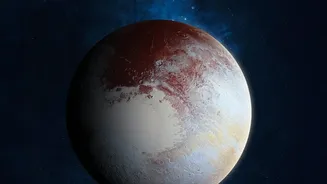
Getting to Mercury seems like it should be easy; after all, it’s much closer than Jupiter. The reality is counterintuitive. It takes more energy to reach Mercury than it does to get to distant Pluto. The main reason is the Sun's immense gravitational
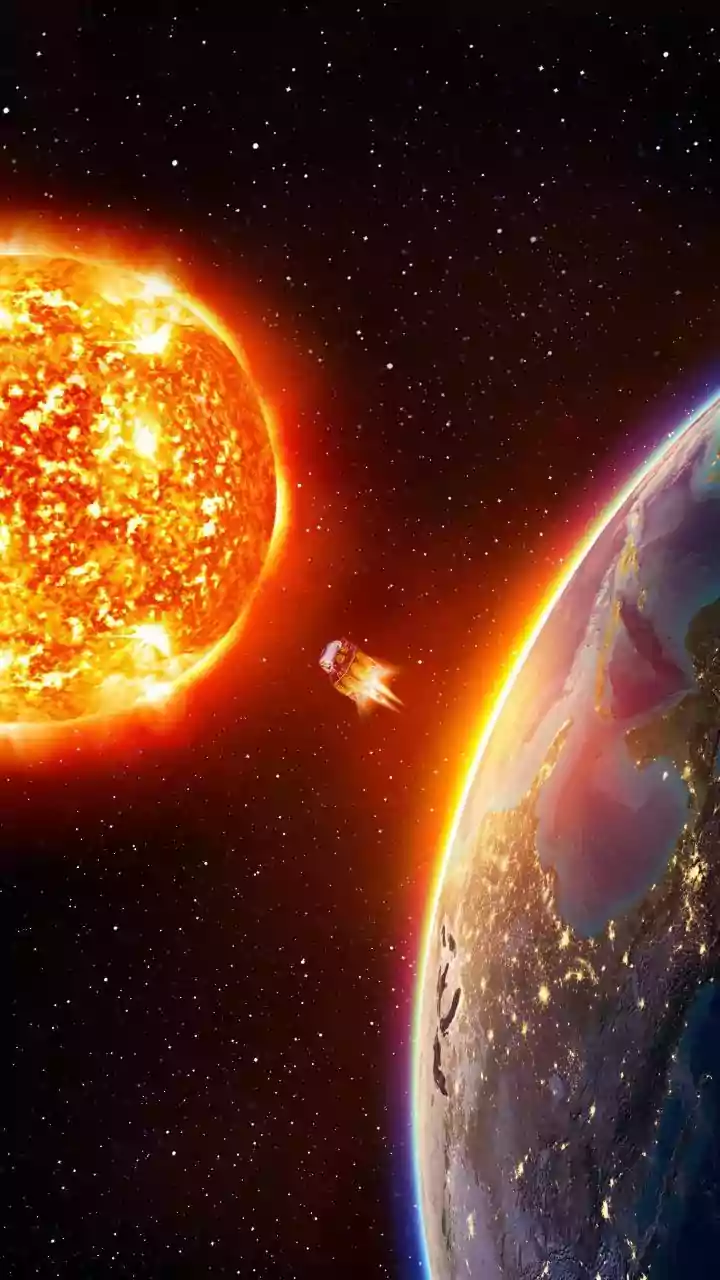
pull. As a spacecraft gets closer to the Sun, it speeds up dramatically, like a car rolling down an increasingly steep hill. To enter a stable orbit around Mercury, BepiColombo must constantly brake against this acceleration. If it arrives too fast, it will simply fly past the planet and be pulled into the Sun or flung into a useless orbit. This makes slowing down, not speeding up, the single biggest challenge.
A Complex Dance of Gravity Assists
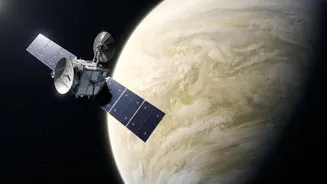
BepiColombo can’t just slam on the brakes with powerful rocket engines; it doesn't carry enough fuel for such a brute-force manoeuvre. Instead, it has spent years executing a series of nine precisely calculated gravity-assist flybys. This cosmic 'slingshot' technique involves using the gravitational pull of planets to adjust its speed and trajectory. The journey included one flyby of Earth, two of Venus, and six of Mercury itself. Each flyby acted as a brake, incrementally shedding velocity and nudging the spacecraft closer to the correct path for orbital insertion. This complex sequence was essential to reduce the spacecraft's energy enough to be captured by Mercury’s weak gravity.
The Gentle Push of Ion Thrusters
In between the planetary flybys, the mission relies on a state-of-the-art solar electric propulsion system. Housed in the Mercury Transfer Module (MTM), four ion thrusters provide a gentle but persistent braking force over long periods. These thrusters work by using electricity from massive solar arrays to charge xenon gas and expel ions. The thrust produced is incredibly low—at full power, it's equivalent to the weight of just a few coins. However, by firing continuously for months at a time, these engines have been crucial in gradually slowing the spacecraft, allowing it to line up for its flybys and the final orbital insertion. On September 3, 2026, after completing its job, the transfer module successfully separated from the two science orbiters, marking the official start of the arrival phase.
The High-Stakes Arrival Sequence
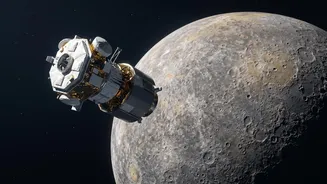
The European Space Agency has called the arrival its 'most operationally challenging' ever attempted. With the transfer module gone, the two science orbiters—ESA's Mercury Planetary Orbiter (MPO) and JAXA's Mercury Magnetospheric Orbiter (Mio)—are now coasting toward their destination. The capture into Mercury's orbit, planned for November 2026, will be a moment of high tension. The spacecraft must approach at the perfect speed and angle to be 'weakly captured' by the planet's gravity. Because of the immense distance, there is a significant time delay for communications, meaning the spacecraft must perform these critical steps autonomously. Following the initial capture, another series of manoeuvres will place the two orbiters into their separate, specialised orbits in December, before science operations begin in 2027.