
More Than Just Dust
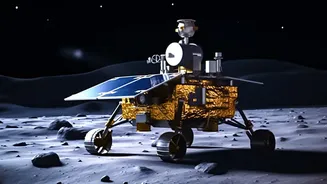
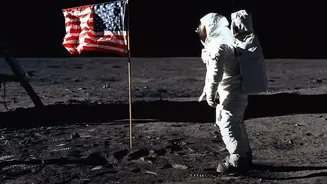
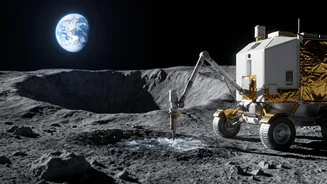
To the Apollo astronauts, it was one of the biggest surprises of lunar exploration. The fine, grey powder covering the Moon, known as regolith, was a major nuisance. Unlike dust on Earth, which is weathered by wind and water into rounded particles, lunar dust is composed
of tiny, sharp, glass-like shards. Formed by billions of years of micrometeorite impacts, this material is abrasive and, due to solar radiation, electrostatically charged. This charge makes it cling to everything it touches—spacesuits, equipment, and solar panels. Apollo 17 commander Eugene Cernan called it one of the most “aggravating, restricting facets of lunar surface exploration.” The dust wore through layers of spacesuit fabric, clogged mechanisms, caused equipment to overheat, and even followed astronauts into their lunar module, causing respiratory irritation sometimes dubbed "lunar hay fever."
A Storm of Tiny Daggers
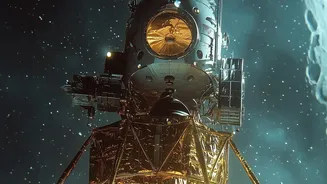
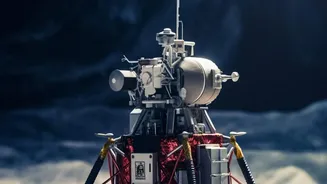
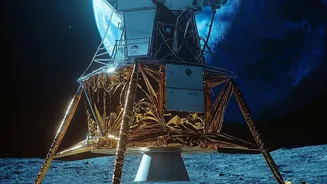
The problem gets far more serious during a powered landing. A descending spacecraft’s rocket engine exhaust doesn't just gently blow the dust away; it creates a high-velocity, supersonic blast that kicks up regolith with destructive force. This plume of ejecta can act like a sandblaster, posing a significant threat to the lander itself and any nearby hardware, such as a future lunar base, scientific instruments, or other vehicles. The particles can travel fast enough to go over the lunar horizon, creating a widespread hazard zone. Understanding this phenomenon, called plume-surface interaction (PSI), is crucial for designing safe landing procedures and protecting expensive and life-sustaining assets on the Moon.
Simulating a Lunar Landing on Earth
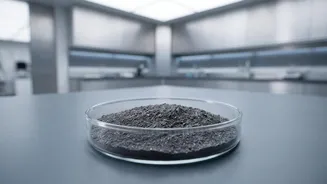
To study these effects, NASA has initiated a series of sophisticated experiments at its Langley Research Center in Virginia. Inside a massive, 60-foot spherical vacuum chamber, engineers are firing scaled-down rocket engines at a bin of simulated moon dirt. This simulant, known as BP-1, is a crushed basalt from a volcanic region in Arizona that mimics the sharp, abrasive texture of actual lunar regolith. In test runs lasting only about six seconds each, a battery of instruments, including high-speed cameras and Doppler radar, measures everything from the size and shape of the resulting crater to the velocity and distribution of the ejected particles. As one NASA lead described it, this is the most complex test of its kind ever attempted in a vacuum chamber.
Data for the Artemis Generation
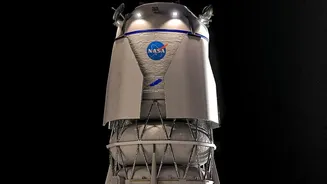
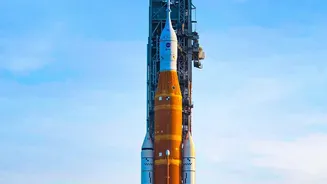
The data from these tests is vital for NASA's Artemis program, which aims to establish a long-term human presence on the Moon. The findings will help engineers validate and improve their predictive computer models, which are essential for designing the next generation of human landing systems. By accurately predicting how rocket plumes will disturb the lunar surface, NASA and its commercial partners can develop safer landers, create strategies to mitigate dust, and plan the layout of future lunar outposts to avoid damage from landings and launches. This research will directly influence the design of hardware for missions like Artemis IV, scheduled for 2028, which will be critical for building a sustainable base at the lunar south pole.
Blueprint for Exploring Other Worlds
The lessons learned from studying the Moon's dust problem extend beyond our closest celestial neighbor. The physics of plume-surface interaction changes depending on the environment; landing on Mars, with its thin atmosphere, will present a completely different set of challenges than landing on the airless Moon. The models and testing methodologies being refined today will provide a crucial foundation for designing missions to the Red Planet and beyond. By understanding how to safely land on dusty, alien surfaces, we are not just solving a problem for the Moon, but developing a core competency for the future of human exploration across the solar system.