





The Old Picture: A Cosmic Mosh Pit
The prevailing theory of galaxy formation, known as the hierarchical model, has long painted a dramatic picture of the universe's youth. Shortly after the Big Bang, small clumps of matter and dark matter began to merge under the force of gravity. This
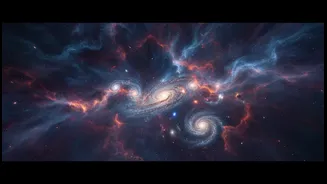
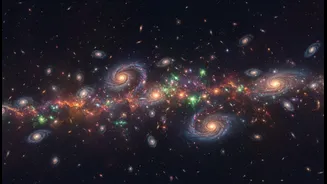
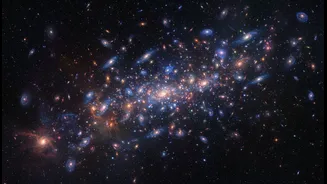
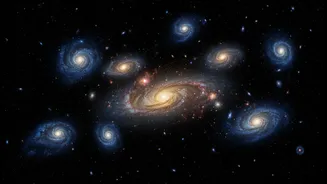
process was thought to be turbulent and violent. Scientists envisioned a cosmic mosh pit, where fledgling galaxies were not the grand, spiral structures we see today, but chaotic, irregular collections of gas and stars, frequently crashing into one another. This 'bottom-up' assembly was expected to take billions of years to settle down into the well-ordered galaxies that populate the modern universe, like our own Milky Way.
A New Eye on the Dawn of Time
This long-held view was based on the best data available, primarily from telescopes like the Hubble Space Telescope. While revolutionary, Hubble has its limits. The incredible expansion of the universe stretches the light from the most distant, and therefore earliest, galaxies into infrared wavelengths that are difficult to observe from the ground or with older space telescopes. Enter the James Webb Space Telescope (JWST). With its massive mirror and advanced infrared instruments, JWST is a time machine built to pierce through cosmic dust and capture the faint light from the universe's dawn. It is providing an unprecedentedly clear view of galaxies that existed less than a billion years after the Big Bang, and what it's seeing is forcing a major rewrite of cosmic history.
An Unexpected Discovery of Order
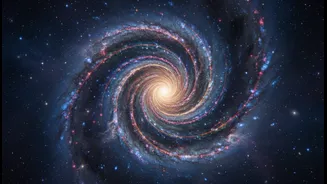
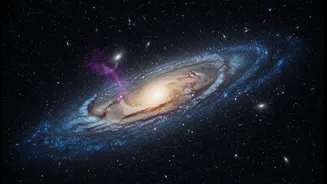
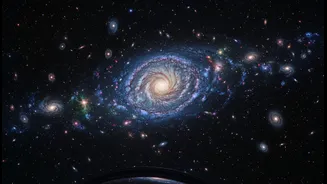
The latest wave of discoveries challenges the old chaotic model directly. A recent study from astronomers at the Inter-University Centre for Astronomy and Astrophysics (IUCAA) in Pune found that some of the earliest 'spheroidal' galaxies were already remarkably organised. These ancient, rounded galaxies, observed when the universe was less than a billion years old, already followed a fundamental law of galaxy architecture known as the 'Kormendy relation', which links a galaxy's size to its brightness. This implies they weren't random clumps, but had already settled into a stable structure. Other JWST studies have found galaxies with well-defined spiral arms and bars far earlier than predicted, structures that were thought to take billions of years to form. These are not the messy toddlers scientists expected; in many ways, they look like miniature adults.
But Chaos Still Reigned for Many
However, science is rarely a simple story. As JWST gathers more data, a more nuanced picture is emerging. While some massive galaxies appear to have gotten their act together quickly, other research suggests this wasn't the case for everyone. A separate, large-scale study looked at over 250 of the more common, lower-mass galaxies from the same early epoch and found the exact opposite. The majority of these galaxies were, in fact, messy and turbulent, with gas flying in all directions, just as the older theories predicted. So, which is it? Were early galaxies orderly or chaotic? The answer appears to be 'both'. It suggests there wasn't one single path for galaxy formation.
Rewriting the Galactic Origin Story
This seemingly contradictory evidence is actually a major breakthrough. It means the story of galaxy formation is more complex and interesting than we thought. It's possible that massive galaxies had a different, faster path to maturity. They may have formed from more intense, but stable, inflows of gas that allowed them to settle into ordered disks rapidly. Meanwhile, their smaller cousins followed the more chaotic, merger-driven path that was long considered the standard model. The key takeaway is that the early universe was not a uniform, homogenous place. It was a diverse ecosystem of galaxies evolving at different rates and in different ways. The challenge for astronomers now is to figure out what factors—mass, environment, or luck—determined which path a young galaxy would take.