




A Mission of Duality
BepiColombo is a joint mission between the European Space Agency (ESA) and the Japan Aerospace Exploration Agency (JAXA). Launched in October 2018, its primary goal is to perform the most comprehensive study of Mercury to date. Getting to Mercury is notoriously
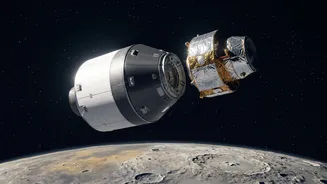
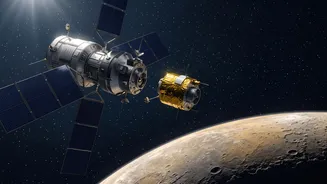
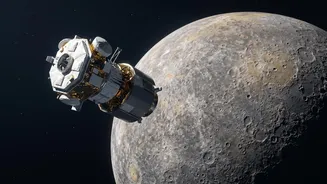
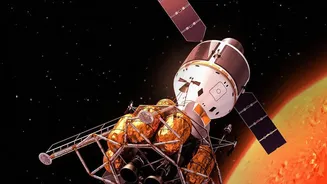
difficult; the Sun's immense gravity makes it challenging for a spacecraft to slow down enough to enter a stable orbit. BepiColombo has spent years making nine gravity-assist flybys of Earth, Venus, and Mercury itself to shed enough energy for its arrival. On September 3, 2026, the mission reached a critical milestone as its transfer module, which provided propulsion for the long journey, successfully separated from the two science orbiters. This event kicked off the final arrival phase, with the orbiters set to be captured by Mercury's gravity in November 2026.
Meet the Orbiters: MPO and Mio
At the heart of the mission are two distinct spacecraft that have travelled together, stacked like cosmic bunk beds: the Mercury Planetary Orbiter (MPO) built by ESA, and the Mercury Magnetospheric Orbiter (Mio) from JAXA. Though they journeyed as one, they are designed to work from two very different orbits after they separate in December 2026. The MPO will settle into a low, circular polar orbit, just 480 by 1,500 kilometres above the surface. This close-up view is ideal for mapping the planet in exquisite detail. In contrast, Mio will enter a much higher, elliptical orbit, ranging from 590 to over 11,600 kilometres. This wider perspective is crucial for studying the space environment surrounding Mercury. The reason for this dual-orbiter strategy is simple: Mercury presents two very different, and equally compelling, sets of scientific mysteries that cannot be adequately studied by a single spacecraft in one orbit.
Solving Different Mysteries
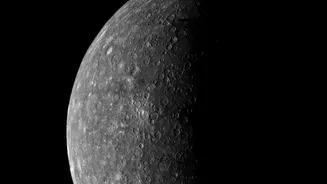
The two orbiters have complementary, not overlapping, jobs. Think of them as a specialist duo, each equipped with the perfect tools for its specific task. The MPO is a geologist and geophysicist. Its 11 instruments are designed to look down at the planet. It will map the surface, analyze the composition of its rocks and minerals, and measure its gravity field to understand what the planet's interior and oversized core are like. It aims to answer questions like why Mercury is so dense for its size and how its strange, pock-marked 'hollows' formed.
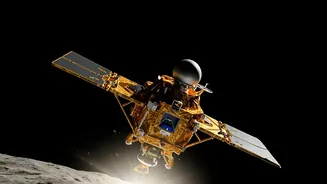
Mio, on the other hand, is a plasma physicist, looking outward. Its five instrument suites are focused on Mercury's magnetic field and its chaotic interaction with the solar wind—the constant stream of charged particles flowing from the Sun. Mercury has a weak but globally present magnetic field, and its proximity to the Sun creates a unique and extreme magnetosphere. Mio will study this environment, observing how the solar wind sculpts the planet's magnetic bubble and replenishes its tenuous atmosphere, known as an exosphere.
A Planet of Extremes
Studying Mercury requires this tag-team approach because the phenomena of interest happen at different altitudes. To understand the surface geology and composition, you need to be close. But to understand a planet’s vast magnetic environment and its interaction with the solar wind, you need to fly through different parts of it, both near and far from the planet. A single spacecraft would be forced to compromise, unable to achieve the optimal orbit for both types of investigation. By using two, BepiColombo gets the best of both worlds. The MPO will hug the planet to create detailed surface maps, while Mio loops far out to sample the broader magnetosphere and its boundary with interplanetary space. This allows for simultaneous measurements, providing a complete picture of how events in the space around Mercury might be linked to phenomena on its surface. For instance, scientists can study how solar wind particles are funneled by the magnetic field to bombard the planet's crust, a process that could alter surface chemistry and contribute to the exosphere.
The Road Ahead
With the transfer module now jettisoned, the conjoined MPO and Mio orbiters are coasting toward their orbital insertion on November 21, 2026. The separation of the two spacecraft is planned for early December. Following this, each orbiter will perform a series of engine burns to fine-tune its final scientific orbit. If all goes according to plan, the main science mission is set to begin in April 2027. For at least a year, this European-Japanese duo will provide an unprecedented, two-point perspective on the least explored rocky planet in our solar system, promising to rewrite our understanding of how planets form and evolve so close to their parent star.