



The Crushing Problem of Nothing
The most immediate danger in space is the vacuum. Here on Earth, we live under a constant, crushing pressure of air molecules, which our bodies are perfectly adapted to. In the near-perfect vacuum of space, that external pressure disappears. Contrary
to movie myths, a person wouldn't instantly explode. However, the results are just as fatal. Without external pressure, the boiling point of liquids plummets. The water in your body—in your skin, your blood, your organs—would begin to vaporize in a process called ebullism. You would lose consciousness in about 15 seconds as oxygen is expelled from your lungs and the deoxygenated blood reaches your brain. A spacesuit's primary job is to counteract this by creating a pressurized bubble of breathable air, acting as a personal atmosphere to keep the body's fluids liquid and supplying vital oxygen.
A World of Fire and Ice
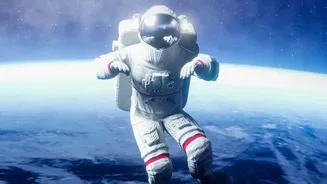
Space has no temperature in the way we understand it on Earth, because there's no atmosphere to hold heat. Instead, an astronaut is subject to extreme thermal radiation. In direct sunlight, the surface of a suit can heat up to 121°C. In shadow, it can plunge to a bone-chilling -157°C. To survive these swings, spacesuits are brilliantly insulated. The outer layers are often white to reflect as much solar radiation as possible. Underneath, multiple layers of aluminized Mylar, separated by fabric, act like a high-tech thermos flask, preventing heat from getting in or out. But insulation isn't enough. Astronauts also wear a Liquid Cooling and Ventilation Garment (LCVG), which is essentially a set of long underwear threaded with hundreds of feet of thin plastic tubing. Cool water circulates through these tubes, pulling excess body heat away from the astronaut and dumping it into space.
Invisible Bullets and Cosmic Rays
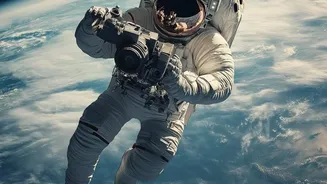
The vacuum of space is not entirely empty. It's filled with radiation and tiny, fast-moving particles. Earth's atmosphere and magnetic field protect us from the worst of this, but in open space, an astronaut is exposed. Galactic cosmic rays and solar flares pose a significant radiation risk, which can damage DNA and increase the long-term risk of cancer. While a spacesuit offers some shielding, especially with its gold-lined visor to protect the eyes from UV radiation, the primary defense against major radiation events is staying inside the more heavily shielded spacecraft. A more immediate physical threat comes from micrometeoroids. Even a particle the size of a grain of sand, travelling at over 27,000 kilometres per hour, can be catastrophic if it punctures a suit and causes a loss of pressure. To defend against this, the suit's outer layers, called the Thermal Micrometeoroid Garment, are made of a mix of tough, tear-resistant materials like Kevlar and Nomex, designed to break up and slow these tiny projectiles before they can reach the inner pressure bladder.
A Personal Spaceship in a Backpack
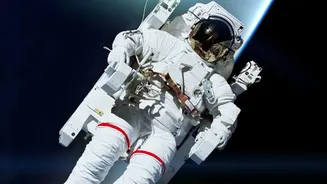
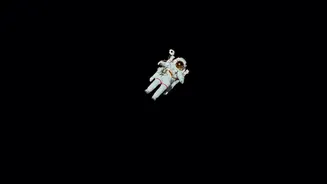
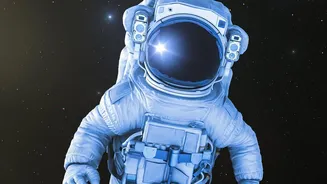
All of these systems are managed by a backpack officially known as the Portable Life Support System (PLSS). This isn't just a backpack; it's the astronaut's personal, mobile spacecraft. It contains the oxygen tanks for breathing and pressurizing the suit, and batteries to power all the electronics. It also houses the fan and pump for circulating oxygen and the cooling water. The PLSS scrubs the exhaled carbon dioxide from the suit's atmosphere, preventing a toxic buildup. It holds the communication systems that connect the astronaut to the crew and mission control, and a reserve oxygen supply for emergencies. For modern suits used on the International Space Station, it also serves as a mounting point for the SAFER, a small jetpack designed to allow an astronaut to fly back to safety if they ever become untethered.