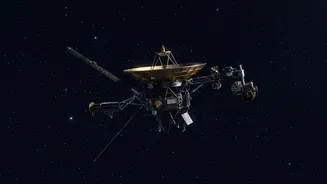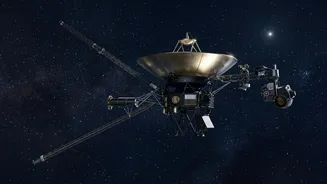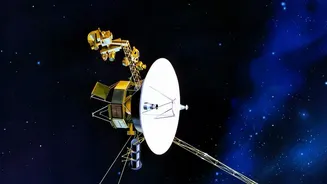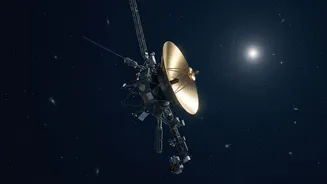


Launched nearly 50 years ago, NASA's Voyager 1 is about to achieve a milestone that redefines distance. The pioneering spacecraft is nearing a point where it will be one light-day from Earth, a first for any human-made object.
Putting a Light-Day into Perspective
To understand the magnitude
of this achievement, it helps to grasp what a light-day is. It's the distance light, the fastest thing in the universe, travels in 24 hours. That's approximately 25.9 billion kilometres. For comparison, light from our Sun takes just over eight minutes to reach Earth. A radio signal sent from Earth to Voyager 1 on November 18, 2026, will take a full day to arrive. The spacecraft is currently travelling at over 60,000 kilometres per hour, a speed it has maintained since its gravity-assisted flyby of Saturn in 1980. It took the probe 49 years to cover this immense distance.
A Grand Tour of the Solar System
Voyager 1 began its journey on September 5, 1977, launched from Cape Canaveral, Florida, 16 days after its twin, Voyager 2. Its primary mission was to explore the outer planets. In 1979, it made a flyby of Jupiter, discovering the planet's faint ring system and active volcanoes on its moon, Io — the first time such activity was seen beyond Earth. In 1980, it reached Saturn, studying its complex rings and making a close pass of the large moon Titan, which was chosen for its dense atmosphere. After this encounter, its planetary mission was complete, and its trajectory sent it hurtling towards the edge of the solar system.
Journey into Interstellar Space
In February 1998, Voyager 1 became the most distant human-made object, surpassing Pioneer 10. A major milestone occurred in August 2012, when the probe crossed the heliopause — the boundary where the Sun's constant stream of particles, the solar wind, gives way to the interstellar medium. This marked humanity's first step into the space between the stars. While it has left the Sun's magnetic and particle influence, it has not yet left the solar system entirely. Scientists estimate it will take another 300 years to reach the inner edge of the Oort Cloud, a vast, icy shell of comets believed to encircle our system.
A Message in a Cosmic Bottle
Aboard Voyager 1 is a message for any intelligent life it might one day encounter: the Golden Record. This gold-plated copper disk contains sounds and images selected to portray the diversity of life and culture on Earth. Curated by a committee led by the famous astronomer Carl Sagan, it includes greetings in 55 languages, music from different eras and cultures, and natural sounds like wind, rain, and animal calls. It also carries diagrams showing Earth's location relative to several pulsars. Sagan noted that the record's launch says something 'very hopeful about life on this planet'.
The Final Chapter of an Epic Mission
Keeping a nearly 50 year old spacecraft operational is a feat of engineering. Voyager 1 is powered by radioisotope thermoelectric generators, which convert heat from decaying plutonium into electricity. This power source is slowly dwindling, losing about four watts of power per year. To conserve energy, NASA engineers have been methodically shutting down instruments. Its cameras were turned off in 1990 after taking the iconic 'Pale Blue Dot' photo of Earth. Despite recent communication glitches that required ingenious long distance fixes, the probe continues to send back data from its remaining active instruments. The mission team expects to maintain contact until around 2036, after which Voyager 1 will fall silent but continue its journey through the void.