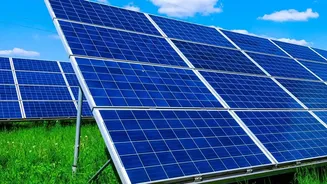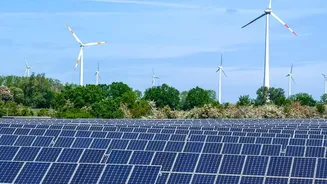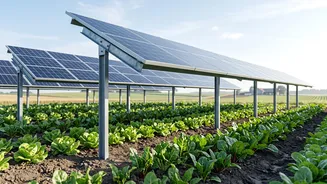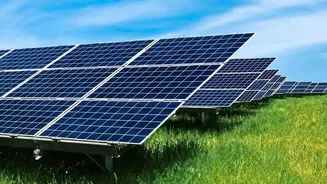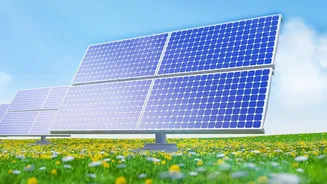





What if the same piece of land could help solve India’s food and energy needs at once? This isn’t a futuristic dream but the reality of agrivoltaics, an innovative approach where farming and solar power generation happen together.
What is Solar Farming?
Agrivoltaics, or agri-photovoltaics
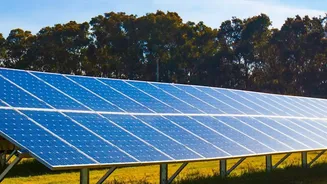
(Agri-PV), is a dual-use system where solar panels are installed on the same land used for agriculture. Instead of covering the ground completely like a conventional solar park, the panels are mounted on structures high enough to allow crops to be cultivated underneath or between the rows. This simple but powerful idea transforms a farm into a source of both food and clean energy, allowing one plot of land to serve two critical purposes.
Why India Needs This Innovation
India faces a dual challenge: ensuring food security for its growing population and meeting its ambitious renewable energy targets. Both demand a huge amount of land. Conventional solar farms require about two hectares of land to produce one megawatt of power, often creating conflict with agricultural needs. With 85% of India's farmers being small or marginal landholders, taking agricultural land out of production for energy is not a viable option. Agrivoltaics offers a solution by stacking functions, making land more productive and addressing the competition between farming and energy. Recent government announcements show a significant policy push, with plans to launch a major agrivoltaics program under the next phase of the PM-KUSUM scheme.
The Dual-Income Dream for Farmers
The most compelling benefit for farmers is the creation of a stable, diversified income. Agriculture is often subject to the volatility of weather and market prices, but solar energy provides a steady revenue stream from selling electricity to the grid. This transforms farmers from being solely 'annadatas' (food providers) to also becoming 'urjadatas' (energy providers). Beyond electricity sales, the panels themselves can improve agricultural outcomes. The shade they provide reduces water evaporation from the soil by up to 30%, which is crucial in arid and semi-arid regions. The panels also act as a shield, protecting crops from extreme heat and hail damage.
The Right Crops for the Job
Not every crop is suited for life under panels. The key is to match shade-tolerant or shade-loving plants to the micro-climate created by the solar installation. Research from institutions like the Central Arid Zone Research Institute (CAZRI) in Jodhpur has shown promising results. Crops that thrive in partial shade, such as turmeric, ginger, spinach, coriander, and other leafy vegetables, are ideal candidates. Pilot studies in India have found that yields for some of these crops either remain stable or even increase due to reduced heat stress. However, major staple crops like paddy and wheat have not yet been successfully trialled at scale. The design of the solar array—its height, spacing, and orientation—is just as crucial as the crop selection.
Challenges on the Ground
Despite its potential, the path to widespread adoption has hurdles. The primary challenge is cost; agrivoltaic systems are 25–30% more expensive to install than conventional ground–mounted solar projects due to the need for elevated structures. This makes the electricity generated slightly more expensive, a gap that needs to be bridged to ensure commercial viability. There is also a lack of standardized designs and business models, and more research is needed to understand the long–term impacts on different soil types and a wider variety of crops across India's diverse agro–climatic zones. Ensuring that farmers receive fair contracts and timely payments for the electricity they generate is another critical factor for success.