




First, What Is a Quasar?
Before we get to the pair, let's break down the individual. A quasar, short for 'quasi-stellar radio source', isn't a star, but it's one of the brightest things in the universe. Imagine a supermassive black hole at the center of a very young galaxy. Now
imagine that black hole is actively 'feeding' on a massive disc of gas and dust swirling around it. The gravitational and frictional forces on this material heat it up to incredible temperatures, causing it to glow with an intensity that can outshine its entire host galaxy by thousands of times. Essentially, a quasar is the spectacularly bright signal flare of a growing supermassive black hole. Because they are so bright, they act like cosmic lighthouses, allowing us to see them across billions of light-years and, therefore, billions of years back in time.
Seeing Double: The Hunt for Quasar Pairs
Finding one quasar is exciting; finding two sitting right next to each other is a major event. Scientists believe that galaxies grow by merging with other galaxies. Since most big galaxies have a supermassive black hole at their core, a galaxy merger should eventually lead to a black hole merger. A quasar pair is considered the tell-tale sign of this cosmic collision in action. It's a snapshot of two galaxies in the process of becoming one, their central black holes both lighting up as they feast on the disrupted gas. However, finding these pairs is incredibly difficult. The quasar phase is relatively short-lived in cosmic terms, so the chances of catching two so close together, both shining brightly at the same time, are slim. This makes every discovery a crucial piece of evidence for how the largest structures in our universe were assembled.
Enter J1602+4228AB
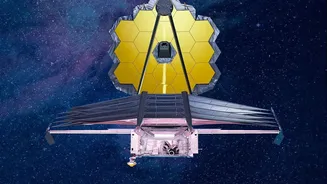
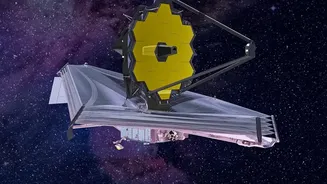
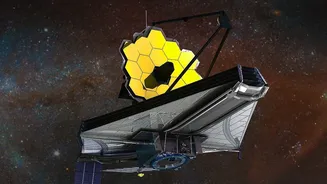
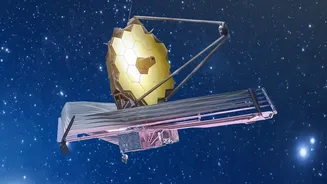
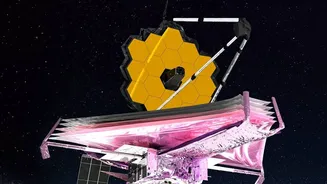
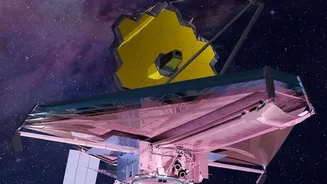
This brings us to the discovery made with the James Webb Space Telescope (JWST) and confirmed with the Gemini North telescope in Hawai'i. Designated J1602+4228AB, and given the Hawaiian nickname Nāpōwawāʻenakaulua, this isn't just any quasar pair. It's the oldest and most distant compact pair ever seen. We are seeing them as they were just 900 million years after the Big Bang, during an era known as 'cosmic dawn'. The two objects are separated by only 18,100 light-years, a cosmic stone's throw that is about one-fifth the diameter of our own Milky Way galaxy. This makes them the most compact pair ever found from this early epoch, a true snapshot of a merger in the infant universe.
The Problem of 'Too Big, Too Soon'
Here's where it gets really interesting and, for astrophysicists, really puzzling. According to our current models, it takes a very long time—at least a billion years—for black holes to grow to 'supermassive' status. Yet the black holes powering Nāpōwawāʻenakaulua are enormous. One weighs in at about 1.5 billion times the mass of our sun, and its companion is around 400 million solar masses. Finding one black hole this massive so early in the universe would be a challenge to explain. Finding two, side-by-side, is a major theoretical headache. As lead researcher Silvia Onorato put it, 'There is no definitive theoretical explanation for how a single one of these giant quasars exists so early in the age of our Universe, much less two'. Their existence suggests that the processes of galaxy and black hole growth in the early universe were far more rapid and efficient than we previously imagined.
A Laboratory in the Early Universe
While Nāpōwawāʻenakaulua breaks some of our models, it also provides a unique opportunity to build better ones. The discovery suggests this system might be located in an exceptionally dense region of the early cosmos, a 'cosmic traffic jam' where galaxy interactions and mergers were happening frequently, accelerating everything. This environment would have encouraged rapid star formation and, at the same time, provided the fuel needed for the black holes to grow at an astonishing rate. This system serves as a natural laboratory for studying how the very first massive galaxies and their black holes assembled together during the universe's formative years. There remains a small possibility that the observation is a case of gravitational lensing—one quasar whose light is being split by a massive object in the foreground—but differences in the light spectra of the two objects suggest they are indeed a distinct pair.