


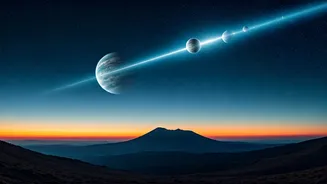
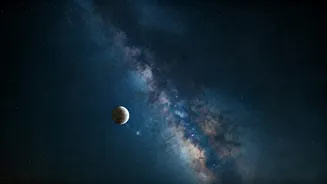


What Is This Planetary Cluster?
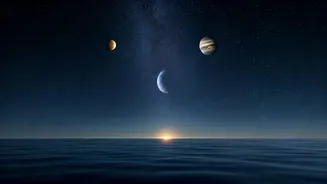
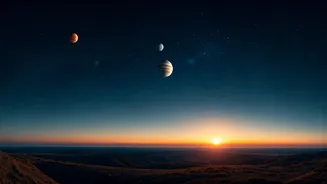
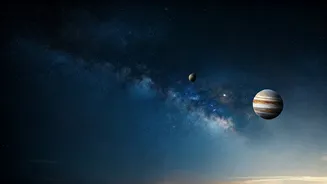
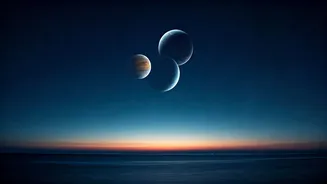
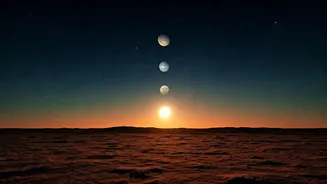
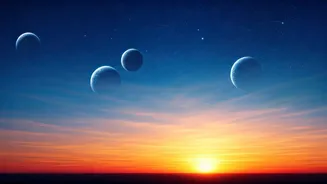
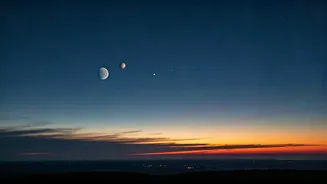
What you're seeing is a planetary conjunction, an event where two or more planets appear very close together in our sky. From our perspective on Earth, their orbital paths seem to intersect, creating a temporary, beautiful grouping. It's important to know
that they aren't actually close to each other in space—they remain millions of kilometres apart. This is purely a line-of-sight illusion, but a spectacular one nonetheless. This particular event involves Mercury, Venus, and Jupiter, three of the five planets visible to the naked eye. Seeing a trio like this isn't an everyday occurrence. While two-planet conjunctions are relatively common, having three bright planets huddled together is a special treat for stargazers and casual observers alike. It’s a fleeting alignment that showcases the dynamic, ever-moving nature of our solar system in a way that’s both accessible and awe-inspiring.
When and Where to Look
The key to spotting this celestial trio is timing. Your best window for viewing is shortly after sunset. Look towards the western horizon, the same direction where the sun just went down. The show begins as the sky darkens from a deep blue to twilight black. In India, this will generally be between 7:00 PM and 8:00 PM IST, depending on your exact location. Don't wait too long, as Mercury, being the closest to the sun, will be the first to dip below the horizon. You’ll have a viewing window of roughly 30 to 60 minutes. The planets will appear as bright, star-like points of light. The main difference? Stars twinkle, while planets typically shine with a steadier, more constant light. Find a spot with an unobstructed view of the western sky, away from tall buildings or trees that might block your line of sight to the horizon.
How to Identify Each Planet
You don't need to be an expert to tell these planets apart. Your main guide will be their brightness. Venus will be the most brilliant object in that part of the sky, impossible to miss. It shines with a dazzling, silvery-white light and is often called the 'Evening Star' for this reason. Jupiter will be the second brightest, appearing as a strong, steady point of light, not quite as brilliant as Venus but still outshining every star around it. The trickiest one to spot will be Mercury. It will be the faintest of the three and will be positioned closest to the horizon. Its faintness is due to its small size and proximity to the Sun's lingering glare. So, to recap: look for the brightest light (Venus), then the second brightest (Jupiter), and finally, scan the area closer to the horizon for the fainter third member of the group (Mercury).
Do You Need a Telescope?
Absolutely not! This is a naked-eye event, which is what makes it so special and accessible to everyone. The planets are bright enough to be seen without any special equipment. In fact, a telescope's narrow field of view might make it harder to see the entire cluster at once. However, if you have a pair of binoculars, they can definitely enhance the experience. Binoculars will make the planets appear sharper and brighter, and you might even be able to spot Jupiter's four largest moons—Io, Europa, Ganymede, and Callisto—as tiny pinpricks of light flanking the giant planet. But even without them, your eyes are more than enough to enjoy the sight. The main requirement isn't technology, but a clear view and a bit of patience.
Tips for the Best Viewing Experience
To make the most of this celestial event, a little preparation goes a long way. First, check your local weather forecast. Clouds are the number one enemy of stargazing. If it’s overcast, you unfortunately won't be able to see the conjunction. Second, try to get away from city lights. Light pollution washes out fainter objects in the sky, and it will make spotting Mercury particularly difficult. A park, a terrace, or a location on the outskirts of town is ideal. Third, give your eyes time to adjust to the dark. It takes about 15-20 minutes for your pupils to fully dilate, which will allow you to see much more detail in the night sky. Finally, if you want to try and capture a photo, use a smartphone with a night mode setting. Rest your phone on a stable surface to avoid blur, tap to focus on Venus (the brightest point), and take the shot. Don't expect professional results, but you might get a lovely memento of the cosmic alignment.