







Your Body's Built-In Calming System
The vagus nerve is the longest cranial nerve in your body, acting as a superhighway of information between your brain and many of your internal organs, including your heart and gut. It's a major component of your parasympathetic nervous system, which
is responsible for the 'rest and digest' response. Think of it as the natural counterbalance to the 'fight or flight' (sympathetic) nervous system that kicks in when you're stressed. When the vagus nerve is stimulated, it tells your body that it's safe to relax, helping to slow your heart rate, lower blood pressure, and ease feelings of anxiety.
The Link Between Breath and Nerves
So, how can you access this powerful nerve on demand, especially during a stressful workday? The answer is surprisingly simple: through your breath. The way you breathe directly impacts your heart rate and nervous system. When you are anxious, your breathing tends to become shallow and rapid, signaling to your brain that something is wrong. Conversely, slow, deep, and intentional breathing stimulates the vagus nerve. Specifically, longer exhales are key, as they activate the parasympathetic response, helping to slow your heart rate and usher in a sense of calm.
Technique 1: Diaphragmatic or 'Belly' Breathing
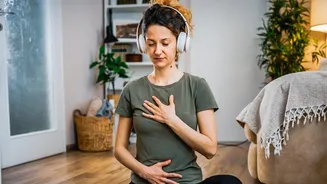
Many of us have adopted the habit of shallow 'chest breathing', especially when stressed. Diaphragmatic breathing, or belly breathing, is a foundational technique to re-engage the diaphragm, the large muscle at the base of your lungs. This practice encourages full oxygen exchange, which can help lower heart rate and blood pressure. To practice, find a comfortable position. Place one hand on your stomach and the other on your chest. Inhale slowly through your nose, focusing on letting your belly expand like a balloon while your chest stays relatively still. Then, exhale slowly through your mouth, feeling your belly fall.
Technique 2: Box Breathing for Focus
If your mind is racing, box breathing (or four-square breathing) provides a simple rhythm to focus on. This technique is used by people in high-stress professions, like soldiers and athletes, to stay calm and focused. The structure is easy to remember, even under pressure. You simply inhale for a count of four, hold your breath for a count of four, exhale for a count of four, and hold again for a count of four. Visualizing a square as you breathe can help you maintain the rhythm and direct your focus away from anxious thoughts. Repeating the cycle for just a few minutes can significantly calm your nervous system.
Technique 3: The Physiological Sigh for Quick Relief
For moments when you need to de-stress very quickly, the physiological sigh is a powerful tool. Popularized by neuroscientist Andrew Huberman, this breathing pattern is something your body already does involuntarily to reset your nervous system. It involves a double inhale followed by a long, extended exhale. To do it intentionally, take a deep breath in through your nose, and then, without exhaling, take another short, sharp inhale to fully inflate your lungs. Finally, exhale slowly and completely through your mouth. Just one or two of these sighs can rapidly offload carbon dioxide and activate your parasympathetic nervous system, providing immediate relief.
Making It a Workplace Habit
The beauty of these techniques is their subtlety. You don't need a special room or any equipment. You can practice diaphragmatic breathing during a meeting, do a few rounds of box breathing before a difficult conversation, or take a physiological sigh at your desk when you feel overwhelmed. The key is to start small. Try setting a reminder to practice for just one minute a few times a day. By making these breathing tools a regular part of your routine, you can build resilience to stress and gain more control over your body's response to workplace pressures.