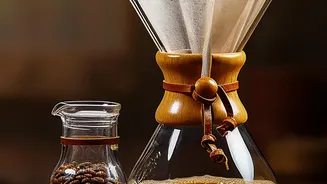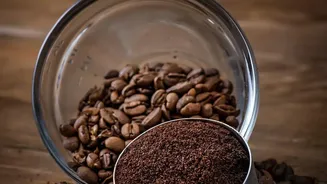






What Exactly Is a Brew Ratio?
A coffee brew ratio is simply the relationship between the amount of coffee grounds you use and the amount of water you brew them with. It's always measured by weight—grams—to ensure consistency. A ratio is written as 1:X, where '1' represents one gram of coffee and 'X'
represents the grams of water. For example, a 1:16 ratio means you're using 16 grams of water for every 1 gram of coffee. Using a ratio, instead of just scooping, allows you to scale any recipe up or down. Whether you're making one mug or a full pot, the taste remains consistent because the proportions are the same.
The Most Important Tool: A Kitchen Scale
If you want to take control of your coffee, the single most important tool you can own is a basic digital kitchen scale. Why? Because measuring by volume—using scoops or measuring cups—is notoriously inconsistent. A scoop of dark, oily beans weighs less than a scoop of dense, light-roast beans. Even the same coffee can be packed more or less tightly into a scoop, changing the amount you use each day. A scale that measures in grams removes all the guesswork. A gram is always a gram, ensuring you can replicate that 'perfect cup' tomorrow and the day after. It's the cheapest, fastest upgrade you can make to your home coffee setup.
Your Starting Point: The 'Golden Ratio'
For most filter brewing methods like pour-over and automatic drip machines, the widely accepted 'golden ratio' is a great place to start. This isn't one single magical number, but rather a range. Most coffee professionals recommend a starting ratio between 1:15 and 1:18. A ratio of 1:16 or 1:17 is often cited as a perfect middle ground for a balanced, flavorful cup that's neither too strong nor too weak. The Specialty Coffee Association (SCA), a global authority on coffee standards, established its 'Golden Cup' standard at approximately 1:18, which is about 55 grams of coffee per liter of water.
How to Adjust the Ratio for Your Taste
The golden ratio is a starting line, not a finish line. The real fun begins when you start adjusting it to match your personal preference. The rule is simple: a lower ratio (less water per gram of coffee) makes a stronger, more concentrated cup. A higher ratio (more water per gram of coffee) makes a lighter, more delicate cup.If your coffee tastes too weak or sour: Your brew might be under-extracted or simply too diluted. Try a 'tighter' ratio like 1:15. This uses more coffee relative to water, creating a richer, bolder body.If your coffee tastes too strong or bitter: Your brew is likely too concentrated or over-extracted. Try a 'looser' ratio like 1:17 or 1:18. This gives each gram of coffee more water to swim in, resulting in a lighter, cleaner cup that can reveal more subtle flavours.
Putting It Into Practice: A Real-World Example
Let's say you want to brew a single large mug of coffee, which is about 350 grams of water (since 1ml of water weighs 1g). Using our balanced 1:16 starting ratio, the math is straightforward.You just divide your total water weight by 16:350g (water) ÷ 16 = 21.8g (coffee)So, you would use about 22 grams of coffee for your 350-gram mug. If you tried this and found it a bit weak, you could adjust to a 1:15 ratio for your next brew: 350g ÷ 15 = 23.3g. You'd use a little more coffee for a stronger result. If it was too intense at 1:16, you could try a 1:17 ratio: 350g ÷ 17 = 20.5g. You'd use a little less coffee for a lighter cup. It’s that simple.
Strength vs. Extraction: A Quick Note
It's helpful to know that 'strength' and 'extraction' aren't the same thing, though your brew ratio affects both. Strength is about concentration—how intense the coffee tastes. Extraction is about which flavors are pulled from the grounds—from bright acids to sweet sugars to bitter compounds. A cup can be strong but under-extracted (sour and intense) or weak but over-extracted (watery and bitter). Your ratio is the primary tool for controlling strength. If you're still getting sour or bitter flavors after finding a strength you like, it's time to adjust your grind size, not your ratio. But for most daily improvements, mastering the ratio is the first and most impactful step.