







The Problem with Sunny-Day Solar
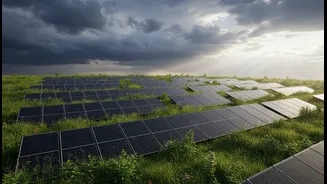
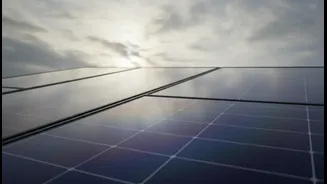
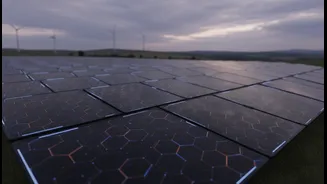
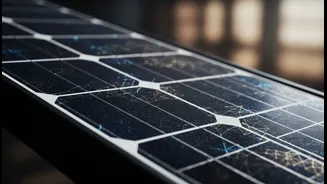
Traditional solar panels, typically made from crystalline silicon, are the workhorses of the renewable energy world. They have become cheaper and more efficient over the years, but their fundamental limitation remains. They thrive in direct, bright sunlight
but see a dramatic drop in performance on overcast days, during monsoon season, or in the early morning and late evening. This intermittency is a major hurdle for any country seeking to rely more heavily on solar power, as it necessitates expensive battery storage or backup power plants to keep the grid stable when the sun isn't shining. This is the core challenge that scientists have been trying to solve for years: how to make solar power a more consistent and reliable energy source, regardless of the weather.
Enter Perovskites and Organics
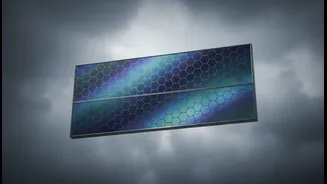
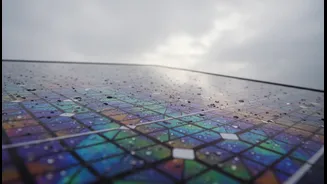
The answer may lie in a new class of materials, primarily perovskites and organic photovoltaics (OPVs). Unlike rigid silicon, these materials are shaking up the industry. Perovskites are compounds with a specific crystal structure that are remarkably good at converting light into electricity. What makes them a potential game-changer is their versatility. They can be 'tuned' to absorb different parts of the light spectrum, making them exceptionally efficient in low-light conditions. Some studies show they can be twice as efficient as silicon in dim light. Similarly, organic photovoltaics, which are carbon-based compounds, are lightweight, flexible, and even potentially transparent. While perhaps less efficient for large-scale power, they excel at harvesting energy from indoor ambient light, such as that from LED bulbs in an office or home.
Rethinking Where Solar Can Go
This ability to generate power from ambient light unlocks a whole new world of possibilities. The most immediate application is for the billions of small electronic devices that make up the 'Internet of Things' (IoT). Imagine smoke detectors, smart home sensors, or electronic shelf labels that never need a battery change because they are constantly being powered by the lights in the room. This eliminates not only the hassle and cost of replacement but also the environmental waste from disposable batteries. For broader energy generation, these technologies could make solar viable in places it wasn't before. Think of buildings in dense cities that are often in shadow, or entire regions in India that experience long, overcast monsoon seasons. By continuing to produce meaningful energy on cloudy days, these new solar cells could provide a more consistent power output throughout the year, reducing reliance on the grid and fossil fuels. Some new designs even stack a thin perovskite layer on top of a traditional silicon cell, creating a 'tandem' cell that captures more of the light spectrum and boosts overall efficiency beyond what either material could do alone.
The Road Ahead Is Still Being Paved
While the promise is immense, it's important to be realistic. This technology is not going to replace every solar panel overnight. The biggest challenge for perovskites, in particular, is durability. Early versions of the material can degrade when exposed to heat and moisture over long periods, which is a significant issue for a product that needs to last 25 years on a rooftop. Researchers are actively working on new chemical formulations and protective layers to solve this stability problem, with promising results emerging from labs, including some at Indian Institutes of Technology. The second hurdle is scaling up. Moving from small, record-setting lab cells to mass-produced, cost-effective large panels is a major industrial and engineering challenge. However, multiple companies are already bringing first-generation products to market, from indoor cells to tandem prototypes, signalling strong commercial interest and confidence in the technology's future.