


A Case of Mistaken Identity
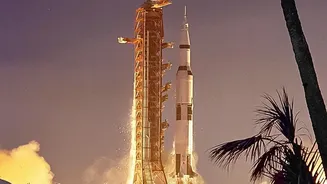
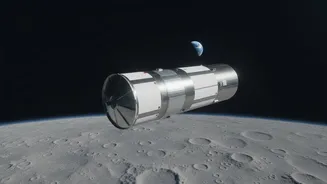
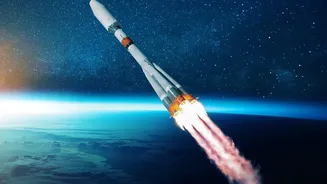
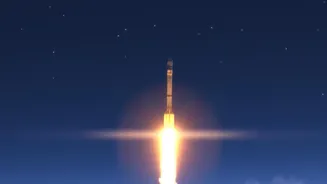
In early 2022, astronomers tracking a rogue piece of space hardware predicted it would crash into the Moon. Early calculations suggested it was the upper stage of a SpaceX Falcon 9 rocket from a 2015 mission. The story of a commercial rocket part accidentally
hitting the Moon quickly gained attention. However, after further analysis, experts revised their assessment. Spectral analysis, which looks at the light reflecting off an object, revealed its composition was more consistent with a Chinese Long March 3C booster from the 2014 Chang'e 5-T1 mission. Despite China's denial, the scientific community largely agrees on the object's origin. The incident highlighted the growing challenge of tracking debris in deep space as more missions are launched by various countries and companies.
Why Scientists Welcome a Crash
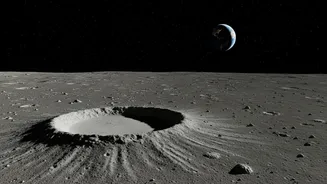
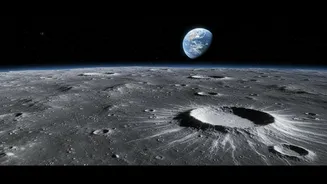
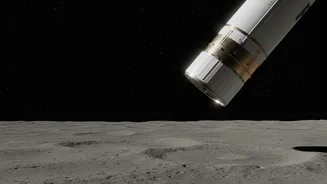
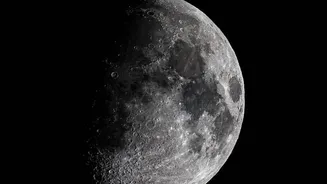
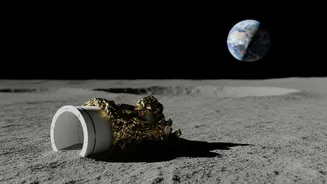
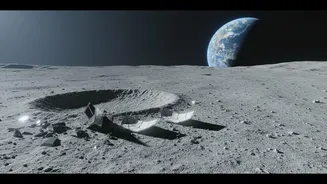
Regardless of its origin, the prospect of the impact excited scientists. Smashing an object into the Moon at high speed is, in effect, a powerful scientific experiment. The Moon has no atmosphere to burn up incoming objects, so it is constantly being hit by meteoroids. These impacts excavate material from below the surface, offering a rare glimpse into the Moon's geology. When the 2022 impactor struck, it was travelling at thousands of kilometres per hour, creating a crater and throwing a plume of lunar dust and rock high above the surface. By studying this plume, called ejecta, with powerful telescopes and orbiting spacecraft, scientists can analyze what lies beneath the Moon's dusty surface without needing to land a rover and drill.
The Hunt for Lunar Water Ice
One of the most sought-after resources on the Moon is water ice. For decades, scientists have theorized that ice could exist in permanently shadowed craters at the lunar poles, where sunlight never reaches. Finding it is a top priority for space agencies, as it could be used for drinking water, to create breathable air, and to produce rocket fuel for future missions to Mars and beyond. An impact event is a perfect way to check. When an object hits one of these dark craters, any ice present would be vaporized and thrown up in the ejecta plume. Instruments on an orbiting spacecraft or even telescopes on Earth could then detect the chemical signature of water. This analysis provides crucial data that informs where future robotic and human missions should land to find and utilize these resources.
A Proven Technique
Crashing things into the Moon for science is not a new idea. In 2009, NASA conducted the Lunar Crater Observation and Sensing Satellite (LCROSS) mission, which was designed to do exactly that. The mission guided the large upper stage of its launch rocket into a collision with the Cabeus crater near the Moon's south pole. A shepherding spacecraft flew through the resulting debris plume, analyzing its composition before making its own impact. The data was a resounding success, confirming the presence of significant amounts of water ice and other useful materials like silver and mercury in the lunar soil. The LCROSS mission proved that impact experiments are a highly effective, low-cost way to probe the secrets hidden in the Moon's coldest, darkest regions.
Future Insights from Lunar Impacts
The accidental 2022 crash and other planned impacts continue to provide valuable data. After the Chinese booster hit, NASA's Lunar Reconnaissance Orbiter (LRO) was able to photograph the new, unusual double crater it created, giving geologists fresh insight into impact physics. Similarly, a Falcon 9 stage that did impact the moon in August 2026 was monitored to study the resulting gas plume. As space traffic in the Earth-Moon system increases, so does the likelihood of more accidental impacts. Scientists will be ready to turn these events into unplanned experiments, collecting data on everything from the composition of the lunar subsurface to the seismic waves the crashes generate, helping us better understand our closest celestial neighbour.