


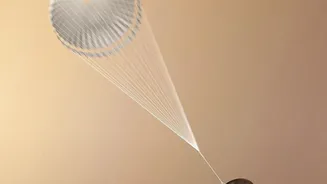


The Challenge of Hitting the Brakes
Entering a planet's atmosphere is one of the most dangerous phases of any space mission. A probe arrives at hypersonic speeds, often traveling many times faster than a rifle bullet. As it ploughs into the upper atmosphere, friction and compressed air
create a bubble of incandescent plasma around it, with temperatures hot enough to melt steel. The goal is to use this atmospheric drag to slow down without burning up. For decades, space agencies have relied on rigid, dish-shaped heat shields to absorb and deflect this intense energy. They have been incredibly successful, but they have a fundamental limitation.
The Tyranny of the Rocket Fairing
A traditional heat shield, or aeroshell, can only be as wide as the rocket fairing—the nose cone that protects the payload during launch. This creates a bottleneck. To land heavier payloads, like a human habitat on Mars or a large, sophisticated rover, you need a wider shield to create more drag and start slowing down higher in the thinner atmosphere. But you can't build a rocket fairing that's impractically wide. This problem has been a major constraint on mission design, limiting the mass of what we can safely land on other worlds. For planetary exploration to take its next giant leap, engineers needed to find a way to break free from this rigid constraint.
Enter the Inflatable Shield
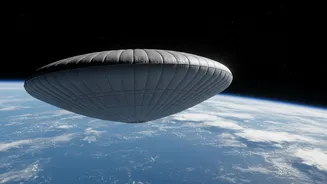
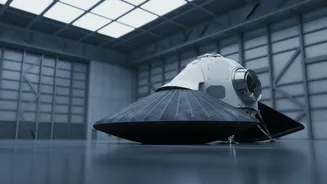
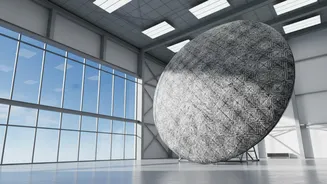
The solution sounds like something from science fiction: a heat shield that you inflate like a balloon. Known as a Hypersonic Inflatable Aerodynamic Decelerator (HIAD), this technology is designed to be packed away tightly for launch. Once the spacecraft approaches its destination, the shield rapidly inflates, transforming from a compact bundle into a massive, lightweight decelerator. Instead of a solid, heavy shield, a HIAD consists of a structure of pressurised rings made from incredibly strong, heat-resistant woven fabrics. This inflatable structure is then covered by a flexible thermal protection system—a high-tech blanket designed to withstand the brutal heat of re-entry.
Bigger, Lighter, and Better
The advantages of this approach are revolutionary. Because a HIAD launches in a compressed state, it can be inflated to a diameter far larger than any rocket fairing could allow. This huge surface area is extremely effective at creating drag in the upper reaches of an atmosphere, allowing the spacecraft to slow down more gently and at higher altitudes. Decelerating in thinner air means lower peak temperatures and reduced structural stress on the spacecraft. This technology makes it possible to land much heavier payloads—think tonnes instead of kilograms. It opens the door to landing the large-scale equipment needed for a human base on Mars or ambitious robotic explorers on Venus or Titan.
A Successful Fiery Test
This isn't just a theoretical concept. In late 2022, NASA successfully demonstrated the technology with the Low-Earth Orbit Flight Test of an Inflatable Decelerator (LOFTID) mission. A six-metre diameter inflatable aeroshell was launched into space, where it inflated and then purposefully plunged back through Earth's atmosphere at more than 28,000 kilometres per hour. The shield survived the extreme heat and forces, slowing itself down before splashing safely into the ocean. The test was declared a huge success, proving that the inflatable design is robust and effective in a real-world re-entry scenario. The recovered hardware was found to be in near-pristine condition, validating years of research and development.
The Future of Deep-Space Landings
The success of LOFTID marks a pivotal moment for space exploration. With this technology now proven, engineers can design missions that were previously impossible. For Mars, this means the potential to land human-rated spacecraft, large habitats, and heavy-duty ascent vehicles needed to bring astronauts home. For India's space program, technologies like this could be critical enablers for future, more ambitious interplanetary missions beyond the successful Chandrayaan and Mangalyaan orbiters. As ISRO looks towards landing heavier payloads on the Moon, Mars, or Venus, developing or adopting inflatable decelerator technology will be a key step. It is a cross-cutting technology that benefits missions to any destination with an atmosphere, including bringing large assets or manufactured goods back to Earth from orbit.