



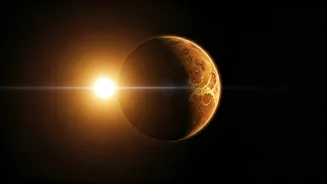


A Day That Outlasts a Year
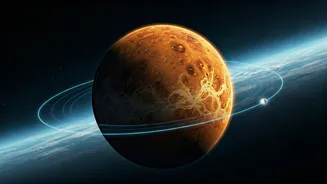
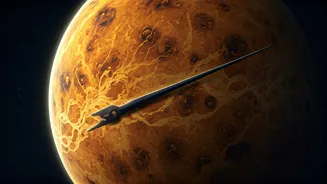
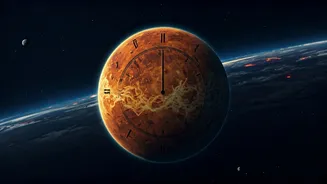
Let’s get the mind-bending numbers straight first. A year on Venus—the time it takes to complete one orbit around the Sun—is about 225 Earth days. However, a single day on Venus, defined as one full rotation on its axis (a sidereal day), takes a staggering
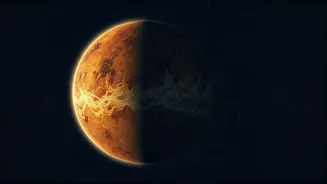
243 Earth days. That’s right: the planet takes longer to spin once than it does to travel all the way around the Sun. This makes Venus the only planet in our solar system with a day longer than its year. To make things even stranger, Venus spins backwards (retrograde) compared to Earth and most other planets. Because of this backward spin, the time from one sunrise to the next (a solar day) is shorter, at about 117 Earth days. Still, that means daylight lasts for nearly two months, followed by two months of darkness.
The Planetary Puzzle
For decades, scientists were baffled by Venus's lazy, backward spin. A leading early theory was a catastrophic impact. The idea was that a massive, planet-sized object must have collided with a young Venus, knocking it so hard that its rotation slowed and reversed direction. This is a plausible explanation for the retrograde spin, as violent collisions were common in the early solar system. However, modelling this scenario has proven difficult. An impact powerful enough to reverse the spin might have been more likely to shatter the planet entirely. More importantly, an impact alone couldn't fully explain how Venus settled into such a specific and incredibly slow rotational speed. It seemed a more persistent, long-term force had to be at work.
The Culprit: A Crushing Atmosphere
The key to solving the puzzle lies in Venus's most infamous feature: its monstrously thick atmosphere. The Venusian air is about 92 times denser than Earth's at sea level, creating a surface pressure equivalent to being 900 metres deep in our ocean. This atmosphere is almost entirely carbon dioxide, which has triggered a runaway greenhouse effect, making Venus the hottest planet in our solar system with surface temperatures around 465°C. But this heavy, soupy atmosphere does more than just turn the planet into a pressure cooker; it physically interacts with the solid planet beneath it, exerting an immense amount of force over geological timescales.
An Atmosphere with Brakes
The primary mechanism slowing Venus down is a phenomenon known as an “atmospheric thermal tide.” It’s different from the ocean tides on Earth, which are caused by the Moon's gravity. On Venus, the Sun’s intense heat warms the thick atmosphere on the dayside, causing the gas to expand and create a massive, dense atmospheric bulge. As the solid planet rotates underneath, the gravitational pull between this heavy bulge of air and the planet itself creates a torque—a twisting force. Crucially, this torque works against the planet's rotation, acting like a giant, planet-sized air brake. Over billions of years, this relentless atmospheric drag has slowed Venus's spin from what was likely a much faster, more 'normal' rotation to its current leisurely pace.
Why It Spins the Wrong Way
The powerful atmospheric tides also help maintain Venus's strange retrograde rotation. While an ancient impact may have initiated the backward spin, it's the atmospheric forces that likely stabilized it. Computer models, primarily using data from missions like Europe's Venus Express, show that the atmospheric torque is so significant that it creates a stable equilibrium point for the planet's rotation. The dense, fast-moving atmosphere—which whips around the planet in just four Earth days—transfers enough momentum to the planet to counteract any tendency to spin faster or in the other direction. In essence, the atmosphere and the solid planet are locked in a delicate gravitational dance that has dictated Venus’s fate for billions of years.